
The Amulet of Samarkand
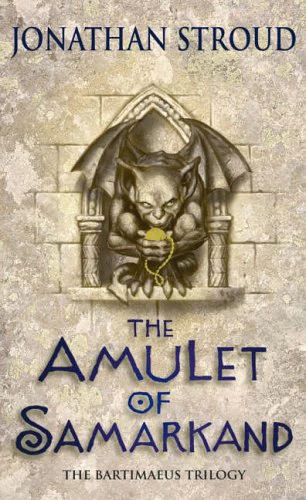
"One of this year's most inventive and ingenious novels." – Nicolette Jones, Sunday Times
A young magician's apprentice, Nathaniel, secretly summons the irascible 5000-year-old djinni, Bartimaeus, to do his bidding. The task for Bartimaeus is not an easy one – he must steal the powerful Amulet of Samarkand from Simon Lovelace, a master magician of unrivalled ruthlessness and ambition. Before long, Barimaeus and Nathaniel are caught up in a terrifying flood of magical intrigue, rebellion and murder.
Set in modern-day London controlled by magicians, this hilarious, bestselling thriller will enthral readers of all ages.
Readers also enjoyed





Jonathan Stroud
Long before ghost-fighting teens roamed the streets of London with iron chains and salt bombs, Jonathan Stroud was already imagining hidden worlds tucked behind the edges of our own. Known for his sharp wit, atmospheric storytelling, and talent for building fantastical universes with a modern edge, Stroud has carved a distinctive path through the landscape of children's and young adult fantasy.
Raised in Bedford, England, Stroud spent his childhood devouring myths and legends, a fascination that would later bloom into stories teeming with ancient magic, restless spirits, and clever young protagonists who don’t always follow the rules. His breakout success came with The Bartimaeus Sequence—a richly layered fantasy set in an alternate London where magicians hold sway, demons serve under duress, and the line between hero and villain is always in flux. Stroud’s gift lies in balancing dark themes with biting humor, especially through the voice of Bartimaeus, a sarcastic djinni whose footnotes alone could carry a novel.
The Bartimaeus Trilogy
The Bartimaeus Trilogy consists of four books. The current recommended reading order for the series is provided below.


Reviews and Comments

An absolutely interesting novel and trilogy. The Bartimaeus Trilogy has remarkably alike feeling to it than there is in Susanna Clarke's novel Jonathan Strange and Mr. Norrel. The atmosphere is something I would call delicious. There is some very interesting darkness in them, some very interesting conflicts. The Amulet of Samarkand introduces us into the parallel world of our own, into the history not so unlike than the reality we think we know. I certainly like the feeling of the book which has shadows that go somehow even deeper than the grimy veins of humanity that George R. R. Martin brings us. The Amulet of Samarkand is maybe a softer version Jonathan Strange and Mr. Norrel, but it definitely reaches a deep variety of shadows that make so many of the fantasy novels look far too bright in comparison.