
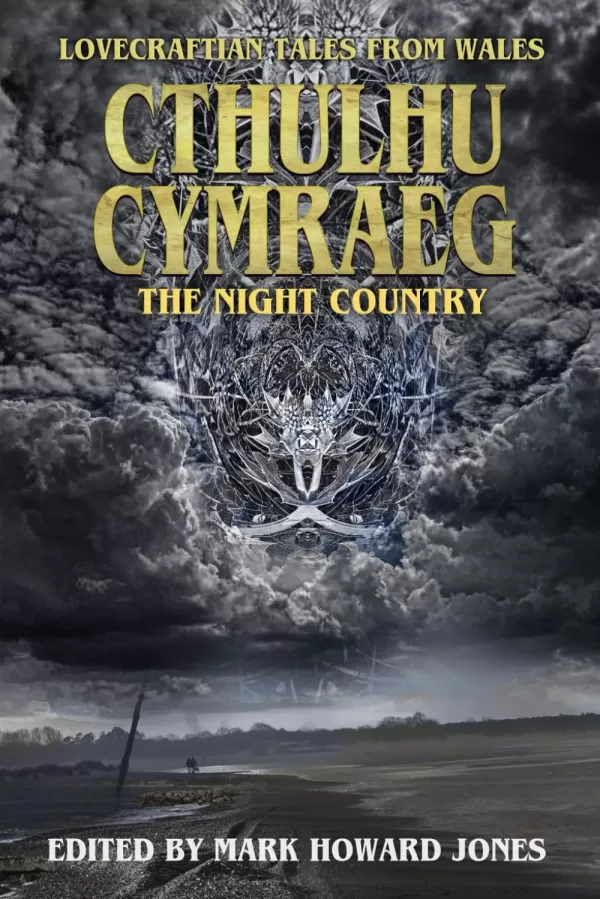
by Mark Howard Jones
The old gods are dead...
The OLDER gods have returned!
Before the American master of cosmic horror H.P. Lovecraft came the Welsh genius of the weird Arthur Machen, who filled his pages with tales of ancient evil.
Now comes this collection of seven NEW stories from the ancient land of Machen, following in the footsteps of Lovecraft and his uncanny creations.
Featuring stories by:
J. L. George
Paul Lewis
C. M. Saunders
Mark Howard Jones
John Llewellyn Probert
Charles Wilkinson
Review: Cthulhu Cymraeg: The Nighty Country (edited by Mark Howard Jones)
Cthulhu Cymraeg: The Nighty Country (edited by Mark Howard Jones) is not merely a rewarding anthology of weird fiction in the tradition of H. P. Lovecraft, but also an affectionate homage to the Cthulhu Mythos. Throughout its pages, the anthology embraces many of the elements readers have come to associate with Lovecraftian weird fiction: ancient forces, unsettling discoveries, forbidden knowledge and encounters with phenomena that lie beyond ordinary human understanding.
I consider this anthology a testament to the enduring fascination of the Elder Gods and the uncanny within speculative fiction. Each of the contributors has crafted a distinctive tale that echoes the chilling atmosphere of classic weird fiction while bringing something fresh and individual to the tradition.
As a devoted fan of weird fiction and literary strange fiction, I was delighted to read this anthology. I found it utterly compelling and enchantingly unsettling, not to mention satisfyingly strange. To be honest, I took the opportunity to read it twice because publishing this review, because the stories are excellent.
The stories included in the anthology are:
Paul Lewis: "The God of the Green"
J. L. George: "The Last Days of Don Juan Jenkins"
C. M. Saunders: "Strzyga"
Charles Wilkinson: "The Madness of T. S. Vargiven"
John Llewellyn Probert: "For I Have Seen the Darkness Moving"
Mark Howard Jones (the editor): "Mad Gods and Englishman"
Charles Wilkinson: "The Men, Hurrying"
The Glossary of Welsh Terms at the end of this anthology is a welcome and useful addition, particularly for readers who may be unfamiliar with the Welsh words and expressions that appear throughout the anthology.
"The God of the Green" by Paul Lewis is an excellent opening story. It follows Cariad, a woman who returns to a small Welsh village upon the death of her mother. There, she finds herself surrounded by a close-knit and supportive community, yet gradually begins to suspect that something strange is taking place after discovering mysterious vials of blood. Lewis weaves an engrossing tale of homecoming, belonging and destiny, bringing it to a satisfying conclusion.
"The Last Days of Don Juan Jenkins" by J. L. George follows a librarian who becomes fascinated by a handsome stranger searching for information about one of his ancestors, whose pursuit of an old Welsh legend brought him from Wales to America in the 1790s. This splendid tale of gay romance, a road trip and strange transformation develops in unexpected ways and is likely to linger in the reader's mind long after the final page. I was impressed by this story, because it is captivating and unsettling in the best possible way.
"Strzyga" by C. M. Saunders is a marvellous tale about Dennis, a security guard working the night shift in a warehouse. When he hears a strange noise, he discovers that something inside one of the crates appears to be trying to scratch its way out. What follows is a satisfying exploration of how an ordinary, rational person reacts when confronted with something completely inexplicable. Its combination of the mundane and the uncanny reminded me somewhat of classic episodes of The Outer Limits and The Twilight Zone.
"The Madness of T. S. Vargiven" by Charles Wilkinson is one of the finest mad-scientist or mad-genius stories I have read in quite some time. It follows Rhun Neagle as he returns to his native community, only to discover that darkness is now strictly enforced in a manner reminiscent of wartime blackouts. He soon learns that everything has changed since the mysterious Night Committee assumed control of the town, and that the reclusive figure living up the hill may be responsible for what is happening. I was utterly captivated by the story and its steadily intensifying sense of unease.
"For I Have Seen the Darkness Moving" by John Llewellyn Probert is another brilliant tale of dangerous scientific curiosity. A doctor visits an old friend who has withdrawn from society to live in a deserted old hotel. He soon discovers that his friend has constructed a device capable of opening a gateway to another dimension beyond our known universe - and that his assistance is required to take the experiment even further. The story contains fascinating echoes of Lovecraft's "From Beyond", while developing its premise in a distinctive direction of its own.
"Mad Gods and Englishman" by Mark Howard Jones is an excellent and grippingly written story about Owen and his fellow Welsh soldiers on the Western Front during the Great War. They gradually become aware that something strange and horrifying may be lurking in the mist in the no-man's land. I was particularly impressed by the author's prose and his storytelling skills. His depictions of the war, the soldiers and the increasingly unsettling events are wonderfully vivid, and he does not shy away from gruesome or disturbing imagery. There is something about the atmosphere that reminded me slightly of the film Deathwatch, in which First World War soldiers encounter an unknown horror amid the trenches of the battlefield.
"The Men, Hurrying" by Charles Wilkinson brings the anthology to an intriguing close. It tells of Bowen, who has purchased an old Bardic chair and begins to experience visions of men running. The story is an appropriately mysterious conclusion to a collection devoted to the uncanny and inexplicable.
Taken together, these diverse tales offer excellent writing, chilling atmospheres and plenty of memorable weirdness. Although the authors approach the weird from different angles, the stories are united by a pervasive sense that ancient, unknowable forces may still be lurking just beyond the boundaries of everyday reality. For readers who enjoy Lovecraftian fiction, Welsh settings and tales in which the familiar gradually gives way to the strange, Cthulhu Cymraeg: The Nighty Country is a rewarding and atmospheric anthology.
Highly recommended!