
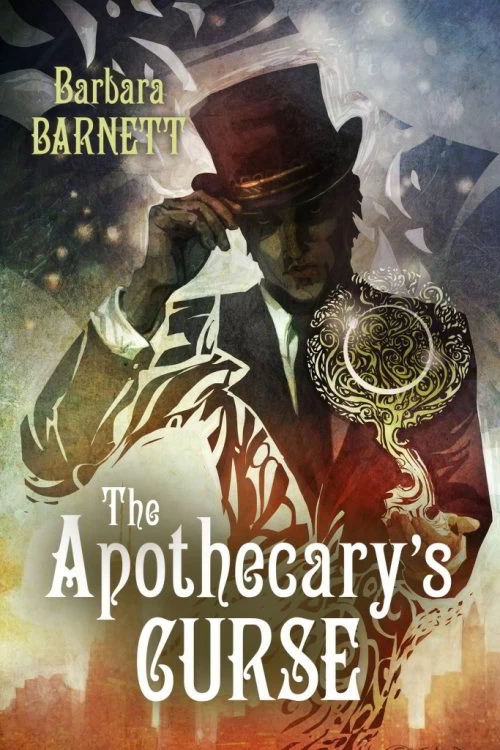
 Barbara Barnett's The Apothecary's Curse was published by Pyr (an imprint of Prometheus Books) in October 2016.
Information about Barbara Barnett:
Barbara Barnett is Publisher and Executive Editor of Blogcritics Magazine and the author of Chasing Zebras: The Unofficial Guide to House, M.D. Barbara has won several awards for her writing, spanning from technical writing achievement to her writing on spirituality and religion. Barbara has a degree from the University of Illinois in biology/chemistry and has worked as a microbiologist. She is the current president of the Midwest Writers Association.
Click here to visit her official website.
Information about The Apothecary's Curse:
This genre-bending urban fantasy mixes alchemy and genetics as a doctor and an apothecary try to prevent a pharmaceutical company from exploiting the book that made them immortal centuries ago.
In Victorian London, the fates of physician Simon Bell and apothecary Gaelan Erceldoune entwine when Simon gives his wife an elixir created by Gaelan from an ancient manuscript. Meant to cure her cancer, it kills her. Suicidal, Simon swallows the remainder - only to find he cannot die. Hearing rumors of a Bedlam inmate with regenerative powers like his own, Simon is shocked to discover it’s Gaelan. The two men conceal their immortality, but the only hope of reversing their condition rests with Gaelan’s missing manuscript.
When modern-day pharmaceutical company Genomics unearths diaries describing the torture of Bedlam inmates, the company’s scientists suspect a link between Gaelan and an unnamed inmate. Gaelan and Genomics geneticist Anne Shawe are powerfully drawn to each other, and her family connection to his manuscript leads to a stunning revelation. Will it bring ruin or redemption?
A REVIEW OF BARBARA BARNETT'S THE APOTHECARY'S CURSE
Barbara Barnett's The Apothecary's Curse is a fresh and utterly compelling cross-genre novel. It's one of the finest and most intriguing speculative fiction novels of the year due to its original combination of fantastical, historical, mythological and scientific elements. It is sure to please a wide audience of readers, because it's a stunningly vibrant novel (it's an amazing achievement in entertaining storytelling).
The Apothecary's Curse feels like a breath of fresh air when compared to many new speculative fiction novels. It has the same kind of old-fashioned charm and arresting originality as Mark A. Latham's Apollonian Casefiles series and Vaughn Entwistle's The Paranormal Casebooks of Sir Arthur Conan Doyle, because the author has come up with a story that feels simultaneously old-fashioned and stylistic.
In this novel, Barbara Barnett combines the atmosphere of an age gone by and the hecticness of modern way of life in a fluent way and leads her readers into Victorian London and modern day Chicago. Nothing feels rushed, because the story moves gently yet decisively forward and thrills readers with various happenings and revelations. Elements of urban fantasy and historical fantasy blend seamlessly in this novel.
The author explores captivatingly such themes and issues as love, loss, hope and immortality. She doesn't shy away from challenging and dark material, but addresses many issues in an entertaining way and gives her readers something to think about.
Here's a bit of information about the story:
- The story begins in London, 1902. Dr. Joseph Bell, Dr. Simon Bell, apothecary Gaelan Erceldoune and Sir Arthur Conan Doyle are having a dinner with guests. Conan Doyle is curious about many apothecaries possibly having been adept in alchemy and even magic and discusses it with Gaelan. He mentions that he has come across Gaelan's unusual surname in his research into the Otherworld where the fae folk rule and has heard of an Erceldoune associated with old legends... A bit later, Simon and Gaelan discuss things and Gaelan says that Conan Doyle's interrogation about his legendary ancestors unsettled him and as did his reference to a book that holds all the diseases of the world and their cures in a singular volume...
- In present day Chicago, Simon Bell writes Sherlockian fiction (Holmes pastiches) under the pseudonym of Anthony C. Danforth. Suddenly he sees his old friend, Gaelan, who now has an antiquarian bookshop. Gaelan is not doing well and confesses that he feels like his hold is slipping these days, because the London Imperial War Museum is under renovation and certain diaries, which contain detailed information about experiments and 'private freak shows' that were carried out there, have been unearthed. He fears that certain people will be able to find out who he really is and where he lives...
This is the beginning of a well written story that'll keep you awake until the wee hours of morning. You'll most likely find yourself turning pages as fast as you can to find out how the story ends. (Yes - honestly - the story is that good.)
The subtly complex story flows effortlessly from the first page to the last page. The first chapter promises readers an extraordinary story and the author fully delivers her promise as the story begins to unfold. Readers are treated to a mesmerising account of the extraordinary lives of two immortals.
The story consists of a set of sub-stories that reveal how Simon becomes immortal, what happens to Gaelan, what happens to Simon's sister, how Anne enters Gaelan's life and how the protagonists try to undo their immortality and find peace.
The happenings take place in Victorian era London and present day Chicago. By writing about different eras, the author creates a story that hooks the reader with secrets, revelations and exceptionally good characterisation.
The characterisation is excellent. The protagonists - Simon Bell and Gaelan Erceldoune - are compelling and satisfyingly complex characters, because they struggle with their lives and deal with feelings of guilt, love, loss and loneliness. Their tortured existence gives the story an impeccable touch of class that separates this novel from other new novels.
Simon and Gaelan became acquaintances in Victorian London. At first they shared a fascination for latest discoveries in the fields of science, philosophy, literary and languages, but then their lives became more connected through Simon's sister, Eleanor. When Simon's wife was dying of incurable cancer, he seeked Gaelan's help. At first Gaelan refused to help him, because he was bitter about the death of his wife and child at the hands of modern physicians who took them away before he could help them. However, he agreed to help Simon's wife, because he was not able to save his own family and gave Simon an elixir that would save Sophie. When Simon gave the elixir to Sophie, her tumours vanished, but she died. Simon became suicidal and drank what was left of the elixir, but soon found out that he was alive and could not die.
Simon and Gaelan try to locate the whereabouts of the mysterious book with otherworldly scientific knowledge that belonged to Gaelan and is linked to old legends. The book has been lost for decades. Gaelan wants to find it, because it's his heritage, but Simon wants to use it to find a way to reverse the elixir's effects and join his dead wife.
Dr. Anne Shaw is a geneticist who is interested in Gaelan after hearing from a doctor who met him in the hospital and marvelled at his quick recovery. The author writes realistically about Anne's feelings, life and work.
Gaelan's inhuman torment at the hands of Dr. Francis Handley at Bethlem Royal Hospital (Bedlam) is described exceptionally well, because the author has a talent for dark fantasy flavoured storytelling that borders on the line of being gothic horror. Gaelan has to endure all kinds of disturbing and sadistic experiments, because Dr. Handley is intrigued by his condition and treats him like a guinea pig in order to find out how reacts to what is done to him. I won't write more about this subject, but I can mention that horror readers will enjoy reading about what happens to Gaelan.
I found it fascinating that famous historical persons appeared in the story in an intriguing and surprisingly natural way. Their cameos added a bit of additional charm to the storyline. For example, Sir Arthur Conan Doyle appears in the story.
I was also fascinated by the ancient book that belonged to Gaelan. I won't go into details about it in order to avoid writing spoilers, but I'll mention that everybody who loves mythology will enjoy reading about it. What is revealed about the book is truly compelling.
Barbara Barnett pays plenty of attention to writing believably about Victorian London and modern day Chicago. Her descriptions about the different eras evoke a distinct sense of time and place that is one of the reasons why the story works well. She doesn't seem to struggle at all when she writes about different places, but writes fluently about them.
There's a charming sense of wonder in this novel that will intrigue readers. It is not often that an author is capable of reaching such a high level of amazement in an entertaining speculative fiction novel as Barbara Barnett has done. When you read the story, you'll encounter wonders and terrors of various kinds and you'll be fascinated by them.
This novel also a mesmerising sense of Holmesian fiction, because the protagonists can be seen as fantasy equivalents to Sir Arthur Conan Doyle's famous fictional characters, Sherlock Holmes and Dr. John Watson. The protagonists' lives and fates are linked to each other in the similar way as those of Holmes and Watson.
I think that the author's expertise as microbiologist has allowed her to write about genetics and scientific elements in a believable way. When I read the story, I got the impression that the author has spent time on researching the material and knows what she's writing about, because everything felt authentic.
Barbara Barnett excels at writing about immortality, love, loss and loneliness. She explores them in a similar way as Anne Rice and Freda Warrington do in their vampire novels and fully succeeds in it. Reading about the characters and how they deal with immortality and issues raised by their unnaturally long life is captivating, because they've experienced many things over the years and are haunted by some of the happenings.
The author's prose is a pleasure to read, because she writes gently flowing descriptive prose. She has an incredibly fresh literary voice and - what's truly important - she has something important to say about life and love. Although the story is speculative fiction entertainment, it has plenty of depth (when you scratch the surface of the story, you'll find a wealth of depth).
One of the most important reasons why I love this novel is that the author lets the story unfolds at its own pace. She avoids too much action and allows the characters to develop naturally. This is something that I miss in many new speculative fiction novels.
Another reason why I love this novel is that it feels fresh. Although the author uses familiar elements, she avoids using clichés and keeps a tight focus on what's important. I admire her for her sense of style and substance.
I sincerely hope that Barbara Barnett will continue to write more speculative fiction novels, because she's a talented author who has her own unique voice. If you've read novels by such authors as Anne Rice, Freda Warrington, Mark A. Latham, Vaughn Entwistle and Kim Newman, you'll love this novel and will find it irresistibly charming.
Barbara Barnett's The Apothecary's Curse is speculative fiction at its most entertaining. I highly recommend this fantastic novel to readers who are intrigued by history, science, immortality, mythology, ancient secrets and Victorian fiction. It has something for everybody, because the author seamlessley blends many elements and brings the story to life by concentrating on writing about the protagonists and their fates. The story is so compelling that you'll most likely devour it in one sitting.
A highly enjoyable novel!