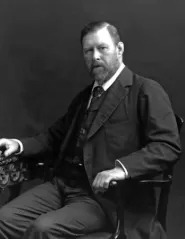
Bram Stoker is remembered today not just as the author of Dracula, but as the architect of a gothic legacy that has both haunted and captivated readers for over a century. Born in 1847 in Dublin, Ireland, Stoker's own life—marked by illness, mystery, and a relentless curiosity—seems almost tailor-made to produce the kind of dark, thrilling stories that would go on to define the horror genre.
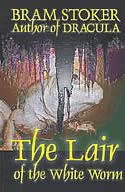
Long before Dracula gripped the world in its eerie embrace, Stoker worked as a civil servant and personal assistant to famed actor Henry Irving. His time with Irving, combined with his deep love of literature, theater, and the supernatural, shaped Stoker’s imagination. He was an avid reader of gothic novels and became fascinated by the folklore of Eastern Europe. Yet, while Dracula would eventually rise to iconic status, it wasn’t Stoker’s only accomplishment—his pen also gave life to other dark tales, such as The Lair of the White Worm, which features his signature blend of horror, the occult, and sinister landscapes.
But it is Dracula that towers above the rest, not just as a story of supernatural terror but as a sharp commentary on societal fears of the time—fears that still resonate today. The novel’s profound influence on pop culture cannot be overstated; it has shaped the vampire mythos and introduced themes of sexuality, immigration, and fear of the foreign, all through the lens of a dark and hypnotic narrative. Stoker's creation of Count Dracula is perhaps the most memorable villain in literary history, a creature whose eerie presence transcends the confines of the novel and continues to inspire countless adaptations in film, television, and literature.
Though much of his life and his personal motivations remain shrouded in mystery, Stoker’s impact on the horror genre is indisputable. His writing style—rich, atmospheric, and at times almost claustrophobic—invites readers into a world where the supernatural is both terrifying and irresistibly alluring. Even in his non-Dracula works, Stoker’s exploration of fear, desire, and the unknown persists, cementing his place as a master of suspense and psychological horror.
Stoker’s own life, while not as widely known as his fictional creations, offers its own sense of drama. His struggles with health, a tense and mysterious marriage, and his deep friendship with Henry Irving paint the portrait of a man who, much like his characters, seemed to thrive in the shadows. Perhaps, as some have speculated, it was his life in the margins—the places where reality and superstition blur—that fueled the dark imagination that gave birth to one of the world’s most terrifying literary works.
Today, Bram Stoker’s Dracula remains as unsettling and relevant as it was when first published in 1897, a testament to the timeless power of fear and fascination with the unknown. In the decades since, his name has become synonymous with vampires and horror, his influence stretching far beyond the pages of his novels.