There Will Be Time
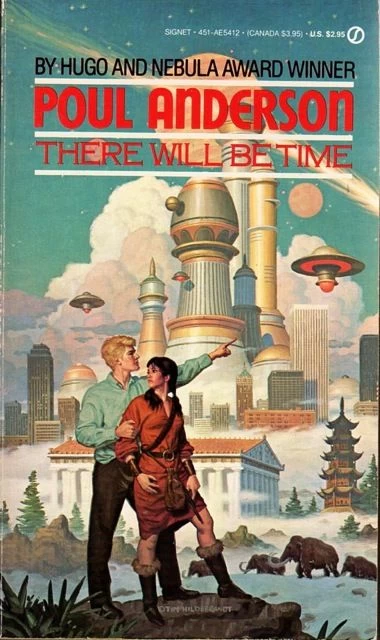
Hugo Award: Best Novel nominee (1973).
Soon after his birth in 1933, Jack Havig's parents experienced the first of many frightening incidents associated with their son. One day he
seemed to appear double, disappear and then reappear before his
terrified mother's eyes. When he was older, his parents were disturbed
to hear him telling wild stories about visits to an Indian camp, stories so detailed and realistic that they seemed more than just the product
of a child's imagination. During adolescence, the boy disappeared for a
long period only to be brought back by a mysterious man who vanished
before he could be questioned.
Eventually Jack realized that he
possessed an incredible power that set him apart from the rest of
mankind. Through the exercise of his will alone, he was able to travel
through time! He had visited the past when America was a greener, more
beautiful land, and traveling to the future, Jack had seen the terrible
consequences of the war.
Catching glimpses of a strange
civilization on the other side of the dark centuries that followed the
dreadful conflict, he wondered if somehow he could help mankind avoid
the war in the first place. If there were any other time travelers and he
could find them, perhaps they could do something to stop the coming
holocost.
After a search that spanned centuried and continents,
Jack found himself in Jerusalem on the day of the Crucifixion. When a
stranger approached him and asked if he were a time traveler, Jack knew
he was not alone. Together with several others, Jack journeyed ahead
through time to America, sometime in the future when savage hordes
called the Mong roamed the land.
The time travelers had build a
fortress called the Eyrie, ruled over by Caleb Wallis, a 19th-century
American. It didn't take Jack long to discover that Wallis was a
power-mad despot whose grandiose schemes for "saving" civilization posed more of a threat to humanity than a dozen atomic wars. Determined to
thwart Wallis's plans, Jack found himself plunged into a terrifying
struggle that would sweep him across the very face of time itself.
In this gripping, action-packed novel, Poul Anderson, author of such books as The Dancer from Atlantis and Beyond the Beyond, once more demonstrates the Hugo and Nebula award-winning talents that have made him one of science fiction's most acclaimed and popular writers.
Readers also enjoyed






Poul Anderson
Poul Anderson's name is synonymous with the golden age of science fiction, a master of speculative worlds where the future is as vast and varied as the past. Born in 1926 in the United States, Anderson's journey as an author was shaped by his fascination with history, science, and the unknown. A child of the Great Depression, he was drawn to stories that stretched the boundaries of possibility, whether set in the stars or rooted in the depths of myth. Over the course of his career, Anderson built a reputation for crafting intricate narratives that blend hard science fiction with the richness of historical and fantasy elements, making him one of the genre's most respected voices.
More books by Poul Anderson