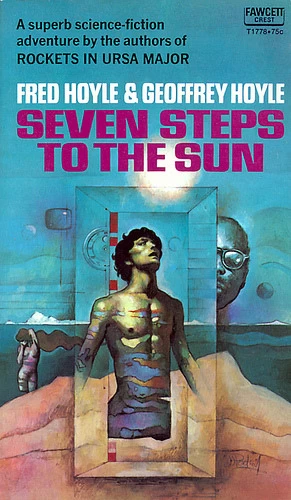
About the Book
Mike Jerome, a likeable young TV writer, visits Proffesor Smitt, a physicist, who gives his an idea for a TV script: using some source of light, perhaps a laser beam, one could reduce the human structure to a form that could be transmitted into the future as electrical pulses – and thus create time travel.
On the way home Mike is hit by a taxi, and when he recovers he finds the date is 1979 – ten years in the future. This is but the beginning of a series of bewildering, fascinating ten year jumps. Mike is himself living the time change himself! At the end of each stop he tries to find his best friend, Pete Jones, a Negro jazz musician. Jumps to 1989, 1999 and so on, take Mike into such far-reaching places as London, the Northern Territory of Australia, California and the Italian Alps, for a rousing series of adventures in all sorts of bizarre circumstances.
At the very end of this outstanding science fiction adventure by a noted father-son team, there is a slyly ambiguous twist which leaves the reader wondering...