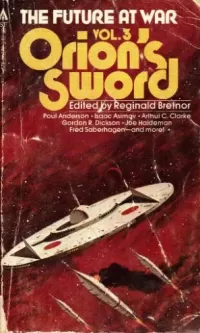
Orion's Sword
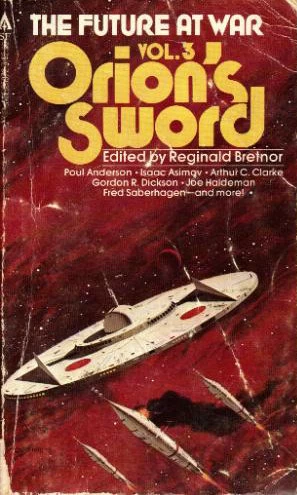
Edited by Reginald Bretnor.
Contents:
- Introduction
- In a Good Cause— by Isaac Asimov
- Chips on Distant Shoulders (essay) by Hal Clement
- Time Piece by Joe Haldeman
- Inhuman Error by Fred Saberhagen
- Couldn't We All Just Be Dear, Dear Friends? (essay) by Keith Laumer
- An Alien Sort of War (essay) by Katherine MacLean
- Early Bird by Theodore R. Cogswell and Theodore L. Thomas
- Inside Straight by Poul Anderson
- World of the Wars (essay) by Jon Freeman
- Superiority by Arthur C. Clarke
- The Steel Brother by Gordon R. Dickson
- Outguessing the Unknown: Psychological Aspects of Future War (essay) by Alan E. Nourse
- City of Yesterday by Terry Carr
- When I Was Red Rover by Dean Ing
- The Wizard Warriors: Computers and Robots in Warfare (essay) by G. Harry Stine
- Field Test by Keith Laumer
- Encased in the Amber of Fate (poem) by Robert Frazier
Readers also enjoyed





Reginald Bretnor
Reginald Bretnor (1911–1992) was born in Vladivostok, Siberia. The family moved to San Diego, California, in 1920. He is best known for his invention of the "Feghoot," extremely short stories which end with a pun. Under the pseudonym Grendel Briarton, he penned Through Time and Space with Ferdinand Feghoot, a series of shaggy-dog-story SF puns which ran for years in The Magazine of Fantasy & Science Fiction,Venture, and Asimov's Science Fiction. A Feghoot collection was published by Paradox Press (1962) and Mirage Press published two other editions: The Compleat Feghoot and The (Even More) Compleat Feghoot. His final novel was Schimmelhorn's Gold, a collection of Bretnor's stories about an oversexed octogenarian idiot/genius.
The Future at War
The Future at War consists of three books. The current recommended reading order for the series is provided below.