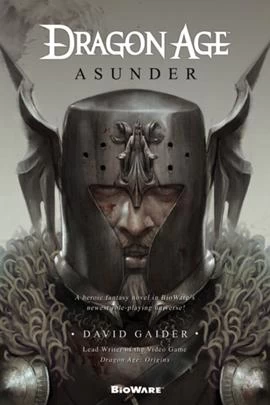
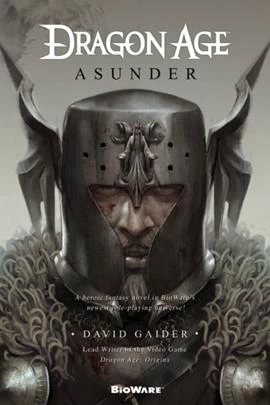
Asunder
The destruction of Kirkwall's Circle of Magi has brought chaos to the lives of mages and templars throughout Thedas. Some mages teeter on the brink of rebellion against their templar watchers, while others struggle to maintain order and stablity amid the tides of change.
In the magestic White Spire, at the heart of templar power in Val Royeaux, tensions have reached the boiling point. The actions of a few radicals draw the attention of the seekers, a powerful and secret segment of the templars, who arrive to take command and restore order no matter the cost. To make matters worse, a mystical killer stalks the White Spire's halls, invisible to all save one lone mage.
As Rhys is the only one who can see the killer, all eyes turn to him as the prime suspect in the murder investigation. With little hope of proving his innocence, Rhys' future looks to be short and grim. But his skill with spirit magic earns him a reprieve, as he is drafted into an expedition traveling deep into the western wastlands of Orlais. There, his fate will become entwined with that of a beautiful templar, a tormented soul, and Wynne - heroine of the Blight. Together they will uncover a secret far greater than they imagined. One that will change the fate of mages in Thedas forever.
Readers also enjoyed
David Gaider
David Gaider lives in Edmonton, Alberta, and has worked for video game developer BioWare since 1999. He is the lead writer on the upcoming Dragon Age: Origins role-playing game and has previously worked on such titles as Baldur's Gate 2: Shadows of Amn, Star Wars: Knights of the Old Republic, and Neverwinter Nights.
Dragon Age
Dragon Age consists of 5 total books. The current recommended reading order for the series is provided below.
Related series Dragon Age (graphic novels)
Reviews and Comments
As a reasonably big fan of the Dragon Age series, I thought it might be prudent to read Asunder, which takes place not long after the second game, and offers some insight into what might be happening in the third game. While I have a lot of respect for what goes into the making of video game worlds, and I think Thedas is actually a really wonderfully written world, I think Gaider should avoid writing novels at all costs. The book had some interesting insights, as promised, into the world and upcoming games, and you get to learn a bit more about Wynne and find out what Shale's been up to since the first game. However, it was 414 pages of the most mediocre writing I've ever been exposed to. To say one good thing about the book, possibly the only good thing I have to say, was that Cole was a really interesting character. You spend the entire book wondering exactly what he is, and the way it ended was intriguing enough. Not to say the quality of how he was written was much better than the rest of the characters, but he alone was a reason to keep turning pages. But on to my complaints - let's start with the prose itself. It's flat. It's undynamic. There was not a single sentence that was memorable unless it was so bad that it made me laugh. The descriptive writing is perfectly adequate to set a scene, but he uses the most generic, uninteresting language possible. And every time he does throw in a good line, it seems out of place and awkward against the rest of the writing. Likewise, if he uses a big word, it is again so out of place that it shouts, "Look at how smart I am! Do you see?" And the characters... oh the characters. Gaider seems completely incapable of writing more than about 10 characters total. Every character he's ever written is a derivation of one of these. Examples of these "soggy two-dimensional pieces of cardboard," as a friend of mine puts it: there is Strong Female Lead (played by Evangeline in this book), the tough and moral female character, who often has to struggle between doing what she must and what is right. Then there is Alistair. If you played the first game, you'd know him. He's the handsome and charismatic joker. And I kid you not, Rhys was Alistair. He made the exact same jokes, and was constantly described as "handsome" and "charismatic"... just like Alistair. With no hint of exaggeration, every single one of Rhys' smartass remarks was the exact same thing you would expect to hear Alistair say. In fact, I wouldn't be surprised if some of them were the exact same jokes Alistair made. Also, the jokes were implanted into some of the most inappropriate places in the book - places where it might work if you're listening to your AIs banter in the background in a video game, but definitely not appropriate places for a novel. And flat characters indeed. Their personality traits never feel real, but mostly just tacked on to make them distinguishable from one another. One character, Adrian, has a feisty temper and hates horses, but there's no reason as to why she's got a temper, or why she hates horses. Then it's just mentioned in a throw-away comment that, for some unexplained reason, she now cares deeply for the horses and has named them all. No explanation as to why she had a change of heart, or anything. Nothing has any depth to it. Even the budding romance was based on little more than, "you're actually a rather decent person, and I find you awfully attractive." Another issue I had was that there is no feel of age distinction. Most of the characters are nearing 40 but act as though they're about 18 (incidentally, wasn't that about how old Alistair was supposed to be?), and a letter written in the end by the Lord Seeker, who is a hardened and mean old warrior, read in the exact same way a teenage girl writes a nasty letter to someone she hates. The last major complaint I had was the attempt to make video game battle logic, well, logical. Because let's face it, video game battles have no logic in them, for the most part. When you try to make something like that logical in a book, it just doesn't make sense. For example, one mage casts what was clearly the Firestorm spell from the games, and it saps her dry of mana. If she was a senior enchanter, you'd think she'd have enough mana to cast more than one spell - in the game she would. But she couldn't. And why not bring mana potions, or something? There are writing techniques that work around these awkward situations, but Gaider is apparently not familiar with any of them. It also opens up several plot holes, which basically all amount to Gaider not being able to juggle all the information he's given over the years. For a simple example that doesn't offer any spoilers to this book (minor spoilers for all three games), if Kristoff (DA: Awakening) was dead when possessed by Justice, and his body was rotting, why wasn't Wynne (DA: Origins) rotting in the over ten years she was brought back by a spirit? Gaider has claimed in blogs that if Anders died and Justice repossessed his body at the end of DA2, his body would rot away eventually. So really, the logic doesn't synch up. All-in-all, if you like the game series and the world and want to know more about it, by all means give it a read. It doesn't take long and the story is interesting enough to keep you going. Unfortunately, the quality of the writing is sub-par at best, and it might start to point out some flaws in the logic, which has the possibility to ruin the game for you a bit if you know a lot of the lore already.