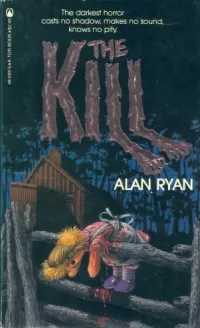
Alan Ryan (1943-2011) didn't leave us much. There's 4 novels, 3 short story collections, and one novella that I am aware of. His creative niche was in the craze exemplified by paperback turnstiles of silver-foil covers barely containing the wails within at inhuman monsters and serial killers stalking us during the 1980s. Laymon, Wilson, Slade, Garton, Skipp & Spector—to name just a few. Movie-wise, it was Franchise World. Halloween, Elm Street, Friday the 13th. But my bow to the 80s goes to the magnificent cleavage of Elvira, Mistress of the Dark. Corn and carnage turned the final thumbscrew that allowed enough trespass for Horror to enter my tortured soul forever.
But author Ryan didn't tumble into that punji stakepit. Avoiding the splatter/gorror of the Screampunks, he trailed off for the center of things; that jungle clearing of culture that defined us through chicken hearts and weak knees.
The fear of the Outsider. The fear of the Unknown. The fear of unaccomplishment, of breakdown, of Death.
And he understood that the scariest monsters are created not solely on paper or celluloid, but in your own head. Reading an Alan Ryan story doesn't make you turn on all the lights and lock the doors. It simply invites you to read the story again. If you do, you'll find microscopes, telescopes and kaleidoscopes buried in the pages. And acting on those nuanced glimpses engenders an unease, a wariness to blindly trust the world, or any somnambulistic walk though it. The questions that go unanswered can be the most haunting of all.
Take the unnamed protagonist of "The Winter's Tale", for instance. He resides between a deserted apple orchard bearing only bitter fruit and an abandoned church graveyard in a house that "had the look of an aged person who refuses to die but who has grown infinitely weary with the slow passage of time"(p.47). Of course the graveyard is rumored haunted, but the old man doesn't believe in such "esoteric residents"(p.46). In the dead of winter when Nature is at her most inhospitable, the old man starts to feel anxious and lonely. He decides—as an act of neighborly goodwill—to visit the family up the road and sets out through a vigorous snowstorm with gifts of food and a cheery presence. But the neighbors react to his arrival in terror. They threaten him with a heavy iron fireplace poker and slam their front door in his face. "You!" they shout, "the man who dwells by the churchyard. . . Back! . . . Get away!"(p.62). The old man manages to make it home, bewildered by why those people hated and feared him. Agitated, he goes on a rampage and begins shouting into the empty graveyard, "teach those people to know how you feel. . . It's them! They're the ones who keep us(1) here!" He gets a reaction: a "terrible cloud of spinning snow and roaring sound had passed away, in the direction of the road"(p.71).
The next morning, "winter eased its icy grip on the land"(p.72), and the old man looks to melting icicles, his cow calling to be milked, and the blue sky.
I guess it doesn't matter if he died at that moment of harsh rebuff or if he was dead already. Or, like the ghosts and goblins of wind and snow he imagines after he gets home, he passes on later that stormy night. But presumably with the help of his closest neighbors buried in the churchyard, he's earned some contentment knowing "he would always be lonely, but perhaps, in the winters yet to come, even there he would be a little less lonely than in the past"(p.73)(2).
The Back of Beyond holds three stories past this one. If there's a theme, it's uncounted people. Plots seem subservient while they look around brusquely-described walls and doorways on invisible people. Certainly, in "Sexual Exploration is a Crime" the scenery and actions of colorful and extravagant Rio de Janeiro are not recognized further than the obvious charms of Renata, who steals the story away from mousy Jerry Crenshaw, the protagonist. He's come to Brazil to meet girls. More specifically, garotas de programa girls, who will escort—yeah, that sense of the word, too—a monied tourist through a wild and memorable vacation. But Renata is not just a hooker; she's a girlfriend, and she runs true to that territory.
Program girls . . . They just have boyfriends, you know, one after another, tourists, I mean. You meet one, she stays with you . . . Does everything you want, has dinner with you, goes to the movies, goes to the beach, whatever. . . She's your girlfriend . . . They're not like American girls. . . Just feed her and buy her a few things and she'll treat you like a king. And when you head for the airport, she'll cry a little and tell you to come back soon because she'll miss you. And she'll mean it. . . Those Brazilian girls, they just never quit.
—Phil, p.17
But when Renata is killed in an auto accident, her regular station is revealed. Like the old man dwelling in the churchyard, she is considered un-remarkable, disposable, invisible in demise. But when the police deliver Renata's severed leg to Jerry's hotel room for no distinguishable reason, it starts him analyzing their short but fulfilling time together. And, "despite the sadness he felt at her death, the memory of her and the good time he'd had with her brought a little smile to his lips"(p.38). Then his thoughts turn to the practical, like what an inconvenience her leg has brought him. There is no rigormortis yet, so when Jerry starts touching the dead appendage, it reminds him of the best sex he's ever had. When the leg moves against him like a caress, Jerry laughs as if he were bragging to his homies about this incredible adventure.
It's all so neat and tidy and clean, like some prepared soiree. In Jerry's world, happiness is a program; it is a series of packages meant to be opened, used, discarded. In human relations, it's about as honest and considerate as believing Renata's "toes wiggled a little, and again, and then they began slowly to stroke his leg"(p.43).
"Starvation Valley" reminds me of that old Harry Chapman song from 1974, Cat's in the Cradle. It's a bittersweet tale of a grown son and his father making a cross-country road trip. Along the way they stop at a trucker's diner called Janey's and find a page of nostalgia and togetherness out of Norman Rockwell's sketchbook. In contrast, the remaining trip is spent in stares out the window or fumbling the radio for Oldies. Dad gets out at the next major city and flies home. His high falootin' ideas about bonding back with his boy are predictably dissipated like smoke from the exhaust pipe. Ten years later, Dad's on the same road and decides to stop at Janey's. But it's not there and has never been there. That is, according to the people who reside there. The current owner is even wearing a bloody apron so you know dreams from the past are meant to be butchered and not relived, especially when they are built on shaky hopes and unreal expectations. The butcher laughs at the absurdity of a cafe on his property, since the truckers call it Starvation Valley. And Dad says to himself, "Janey's was just a place I had once visited and then left behind and, like so many such places, seems now never to have existed at all"(p.116).
Author Ryan ends this collection with "Mountain Man", arguably the creepiest story in the lot. It is set in a time when the West was "the uncertain edge of the wilderness"(p.117), as we follow a cowboy riding fence named Trask discover another "disappeared" person who used to be a trapper named Hiram Fuller. The old man is emaciated, filthy, smelling like "the bowels of the earth"(p.132), and brain dead as a dirt clod; however, as Trask makes contact with those sharknado eyes when Fuller tells him he ate his horse and follows it with, "Had to. Might eat yours too. Maybe you as well. Best take care. Might come to that"(p.121)—well, Trask is more than just alarmed.
In a world of mysteries and menaces and strange happenings, in which a crazy old man was the least thing to have to consider, Trask could not make out why Hiram Fuller troubled him so much.
—p.130-1
Maybe Trask senses a harbinger, or maybe he instinctively knows it wasn't the what, but the why, and that it—at best—would remain forever uncertain, never giving satisfaction, but always stirring the hair on the back of his neck while he whirled around, seeing nothing behind him.
Trask takes him back to the ranch and they send for the doctor. Meanwhile, Fuller attacks a baby pig with his claw-like hands. Doc diagnoses that "he's not fit for civilization"(p.142), and ruminates about the savagery of raw Nature. "That's his place. Out there. Not here. If you bring it across the line, it brings the wild in with it"(p.143).
So Trask sends a couple of hired hands to treat him like "an injured wolf or bear"(p.142) and take him back to Indian Mountain where he found him. Can't shoot him, but shoulda, 'cause when Trask and buddy Beauchamp check on them later it's like a Hormel slaughterhouse up there. Three horses, two guys becoming worm food, and the third impervious to bullets when he attacks them. Trask belly sticks him and he finally goes down.
What? "Something from the mountain, from the forest. . . Sometimes it comes out and acts up. Never know when"(p.169).
Why? "Like a baby is born and already knows how to suckle. And later it knows how to put one foot in front of the other and walk"(p.172).
Obviously, everybody sees clues but nobody has an answer. Ultimately, it is hinted that blame should be on the impenetrability of unmolested Nature and the whimsy of the Universe. And, from that pedestal, it becomes the debatable logic between the Age of Enlightenment's Noble Savage or de Sade's Survival of the Strongest.
Hogwash. Those conclusions are brought about because author Ryan feeds out too much introspection through his character mouthpieces. This just might as well be the start of the Zombie Apocalypse.(3) The conceptualization here is man's real lack of understanding about the world he lives in and thinks he knows, and the inability to see he needs different, paradigmatic tools to progress. Lock yourself inside a watch and the clockworks will chew you up before you can even begin to contemplate what the timepiece collects.
Alan Ryan quit publishing when the Horror genre hit its drought at the end of the 1980s and didn't pick it up again until 2010. In those 20-odd years he edited magazines and anthologies, re-imagined himself a travel/adventure writer and moved sometime to Rio de Janeiro. The current decade saw him cycling back to Horror with some comeback publishing of stories and a novella. Then pancreatic cancer changed his future. It is a short leap, then, to conclude that author Ryan's worldview sounds like the paranoid abnegation by the cowboys 'round the campfire at the end of Mountain Man.
"Always comes back, though."
And Trask said, "Reckon it never goes away."
"That's it," Beauchamp said.
. . . "What do you reckon will be next?" He voice shaped a lament more than a question. . .
Beauchamp held forth this hands, wide apart, palms upward, empty of reply.
"Or who?" Trask said.
—p.181
Maybe the original query should've been when? I guess it all doesn't matter much if it is you or somebody else. Because, for all of us, that horror starts and ends here.
1) italic emphasis mine.
2) I think Ryan is also being a little teaser here and taking liberties with why the undead act the way they do. I mean, some people deserve to be haunted, doncha think?
3) transformations are off stage but seem quick as any B-rated zombie chewfest.