
Achievements
What's New in My Bookshelf
Although known as a genus of tropical parrots, Amazonas is the largest estado in Brazil, housing primarily the Amazon River Basin. I can't comprehend why author Ryan would settle for such a non-evocative title when the name of this novella should certainly be The Slave Tree. Yeah, it's a journey up the Amazon set at the end of the Age of Exploration. Immediately, amazonas vittata start chortling, Heart of Darkness!, Heart of Darkness! but this story is as similar to that one as it is to Poe's The Gold Bug, but without the cipher's conclusion. Henrietta—our post-'n'-proper Victorian protagonist—is worried her husband Edwin is going insane. Edwin has pretty much been shanghaied by a gorilla-like thug named Crown who has talked him into a woozy partnership involving harvesting a unique and special tree deep in the Amazon jungle. Greed is the hook and Edwin—a weak and loathsome failure of an egomaniacal wimp—is the bait, as Henrietta later becomes the fish. Crown's got a goon squad of half a dozen natives, a bungalow in the junglalow, and a "sack of guns"(p.83) to back his bullying plays. They manage to get to the tree, Edwin's hysteria flows into malaria, Crown skull-shoots his native gang 'cause they now know where the tree is, and Henrietta does whatever Crown wants, except sex, which would just muddle up the hidden motivations and covert hostilities. So, what the fook is the Slave Tree? Well, it looks more like a logo of a tree than a tree, and has pea-like pods six or so feet in length that drop periodically from its branches. Think Finney's 1955 Invasion of the Body Snatchers but with more botanical influence, because it does not make alien replicas of humans, it creates originals. "These things are worth a fortune. We'll collect them, harvest them. They'll be worth even more than rubber. Slave labor without slaves. No problem with laws. These things aren't men, they're not human." —Crown, p.80 The problem is keeping these pod people alive, since they apparently can't make it without a little EMT. That's where Henrietta comes in; Edwin's now as dead as his dream, and Crown has always seen them as nothing more than chattel commodity. Things blow when Crown castrates their lone survivor-of-the-pod, Henrietta takes a mortal gut shot, but not before she gives Crown a Brazilian Necktie. Pod man? He bleeds out the final postscript, and the forest "began moving forward to reclaim the ground it had lost only briefly in its ageless span of time, its secrets still held deep and silent in its heart"(p.124). Admittedly, when there is no explanation for what's at the center of the maze when you find it, I have a tendency to think in allegorical terms. I actually like this kind of technique, as it engenders mystery and a search for contextual clues which make the read more expansive. The problem is falling into the deus ex machina pit, perilously so when you're dealing with possibly the Tree of Life. You know, God's tree. Fortunately, author Ryan keeps it close without flopping out some heavy symbolism or transparent allusions. Just a little bigotry baiting, but nothing like snakes or apples or something, eh?
The hills, he had long since come to know, would permit themselves to be tamed, but they would forever hold back—impenetrable—some secrets in reserve. Fields could be cleared and sown, town built, human lives conducted well or ill, but the hills would remain ever and always silent, private, primitive. —p.262-3 Not his first novel,(1) but The Kill offers an example of how and what you had to do to publish during Horror's Silver Foil Era. It is like an old IBM punchcard giving out a dot-matrix printed schematic of style, content, and structure. There's the tone-setting Prologue, the third-person narration spreading out the ensemble of players and their baffled-up solutions—including snippets from The Contrariety itself—all spring-set with summer stock players following well-trodden similitudes like rural air is sweet and relaxing, innocence gets despoiled, careers are not lifestyles, the Farmer's Almanac usurps Wired magazine. Think back for a moment and you'll find this plot spine among the cobwebs, probably under a different title, but nonetheless . . . picture-postcard burg in the country with farms sharing acreage with wilderness . . . a small-town sheriff getting physically creaky, but a strong, caring protector . . . a Doc Adams-like(2) widowed physician who is benign but crusty . . . a freshly-scrubbed go-getting young couple looking for less bedazzle, more comfort, space, success, good friends and country cookin' . . . idiosyncratic, 10-page players who add color but no consideration . . . a nasty, giant aberration pumped full of enough mystery to keep the pages turning. Upon first brush-through, I can find no distinguishable characteristics clinging to me like burrs from sticker weeds. While perusing, the read is scratchy enough to keep itching, but loses its barbs the second it is closed. Re-imagined later, it is like its fiend at the center: ill-remembered and invisible. That's right. The monster is invisible. We know this 'cause some throwaway character runs videotape as it crushes a girl squatting in the dirt to urinate. Recording shows dead girl torn apart by air. You're not gonna read this foregone effort if you haven't already, so let's jump right into the open grave and sift the broken bones. Apparently, this thing is re-animated from a fossil dating back to pre-historic man, somehow cracked open on a scree-tossed, shale-strewn mountainside above a hamlet charmingly called Deacon's Kill in the Catskill Mountains. Might as well be a Tyrannosaurus Rex with wings and precognition for the credibility it musters. But it's a man alright, because it kills—in order—a milking cow(3), a 9-year-old girl wandering in the woods(4), an obviously-immoral runaway with black-painted nipples named Candy, and, in a Gong Show moment, puts the move on Meagan—our resident yuppie fox—with "something hard, erect, rocklike, prodded at her crotch"(p.277). This resurrected Fred Flintstone might sound like "calloused hands rubbed roughly together"(p.15) or "sand on stones"(p.77), but it smells of a bad batch of misogyny to this nose. 1) That would be Panther, c.1981. "The world's most savage killer cats prowl the streets of New York, hungry for the taste of human blood!" (cover blurb). 2) Gunsmoke (1955-75), longest running TV series ever. 3) This is described by the farmer as if he actually saw it (p.275). And, for all the devotion, sympathy, and decency this novel touts in "country folk", the farmer tells no one, sells his farm, and pulls an Ostrich until the townfolk pry him up when it is time for the third act. 4) Obviously a brat and no good, according to her father. "Goddam kid . . . nothin you do for them is good enough nowadays, nothin."(p.157)
What would be the point of it all without clowns? —Stanton Stokely, p.150 Well, here I am in Deacons Kill again. No one seems to remember Barney Rubble's stoneman attack documented in The Kill from last year. Sheriff John Chard is gone for the Pacific Coast, but Doc Warren's still here. In fact, there appears to be some characters who have morphed into other people or, at the least, changed their names. I mean, take Sally Bissell, for instance. She's got a daughter 9-years-old, like Jacob Helbig's Carla, whose death leads off The Kill. To her daughter, she typically spits out bile like, "honest to God, I swear, you'll be the death of me! What are you up to now?"(Tor PBO, ISBN 0812525418, c.1983, p.35) Sounds just like scrawny ol' Helbig, but in a higher pitch. Danny Lester, remember him? Owner of Danny's Diner who took a header into his own short order grill? Well, he died, but his daughter, Susan, has got the legs of the female lead and is "going to make it on her own"(p.44), which certainly channels some of Megan "yuppie fox" Todd blowing out of NYC for Deacons Kill. But this time, there's no invisible old choda crashing in a fire tower. Just the opposite, as the Kill's valley is blanketed with the worst snowstorm in remembered history. Everyone's trapped for days as everything goes white, freezing, and nondescript. No phones, no open roads, no internet. Lotsa town meetings. Lists and assignments. Shoveling. What a perfect time for clowns to arrive. Susan Lester sees one straightaway in a phantom train pulling into the Kill's railway station on abandoned tracks. It's early into the storm, so it is sluiced off as white-out hallucination. The next day at exactly 9:45am(1) she tells Richie Mead—the fledgling sheriff trying to fill sheriff Chard's holster kit—about the train, not mentioning any grease-painted faces with red, bulb noses. Ringmaster Stanton Stokely materializes to ease furrowed brows over the train's arrival. Everyone who hasn't seen a clown yet is too hurried to pay much attention, let alone spring for a big top ticket. So, with the ensemble cast played out over the Kill each with their separate defining moments, and the 2-day snowstorm chopped into succinct timeframe chapters—some of them lasting mere reading seconds on a single page—the mystery falls to the ominous portent of a Victorian train fulla sick clowns sitting in the snowed-over railway station. The plot has its commas challenged by a double duty assigning of its terrors of the natural (snowstorm) and supernatural (clownstorm) for the victimized population. It sacrifices character development by keeping it minimal for less confusion, and leaving more room for the sticking points of horror to progress the story. With the exception of Susan and Richie's slow-fused attraction sparking into a 4th date sometime in the future, the rest of the cast share a vignette mix from cliched to ghastly actions. The perfect example of this is the sidebar of the Bissell family. Carla's an obvious bullying harridan and her husband, Leon, a slow-brained non-combatant. Little Alice, well, she's pretty much a placard for Sympathy. The whole group is a stereotypical snapshot. Carla browbeats her hubby into driving them out of a dangerous situation into a deadly one. At night, miles out, their van spins out for the final time. Leon tries walking out, carrying his lamb-like daughter. Carla stays in the van and gets her head torn off by a clown. Three-quarters frostbitten, Leon makes it back to town by dawn, unaware he's carrying a slab of ice formally known as his daughter. It goes from the predictable to a quick intake of breath, then exhaled into sweeping pathos. It's Horror in a bottle. With fundamental characterizations and a tight, un-expandable plot(2), the atmospheric part of the formula soars. Author Ryan's conjuring of a snowstorm of this magnitude is breathtaking. And I mean at minus below degrees with wind chill in three digits. He piles lots and lots of verbiage on describing the terror of losing your hold over the physical world. And, although he does not delve deep into what I'd call Carny Noir(3), he uses his clowns not as representations but as scarecrows for a more core sense of man's unease when overwhelmed by the "random savagery"(p.196) of Nature. Isn't a hurricane's path as whimsical as choosing giant floppy red shoes? Isn't lava just orange hair pouring down from a balding dome? Isn't a rodeo clown jumping into a barrel merely us laughing at the hoary face of adversity? And, aren't clowns a reminder to not take ourselves so seriously when mouthing any self-centered directives regarding anything, including Nature's conservancy? No? Well then at least acquiesce that clowns—their original purpose, not what Stephen King wants us to think about them—leave us thinking how silly our notions of superiority are when facing the tremendous magnitude of life on Earth, and that we take ourselves way too seriously, okay? There is not a single clown personality in Dead White, re-affirming their literary use here as signage. They are like highway caution cones in the snow—albeit pointing to themselves!—and burn up faster than presto logs when asked for by the discipline of the plot.(4) There is not plausible grounding for their return to Deacons Kill anyway(5), since its residents did not contribute to their current state of un-demise. Ringmaster Stokely is strictly one-dimensional and not pursued as a worthy adversary(6). All these affectations add up to a de-construction of any clown-based presumptions, indicating a different meaning than what to traditionally expect. It is telling that the clowns go up in flames, the congenital opposite to snow. Deeper meaning? Naw, it's just author Ryan running the clowns-are-scary routine on ya. He just wants to tell you a rousing story, and throw in how it feels to be very, very cold and frightened in a snowstorm. It works. 1) I know this fact because author Ryan has added a typical yet annoying pimple to his thriller-style, ensemble cast outline. Instead of chapters, he's using the ol' tickin' clock organizer to be sure no one falls in behind or gets out of line while tension is ramped around the clockface racing into the final timeout. 2)The driving point is, of course, to solve the mystery, and if you don't see restitution—or, at least, its green-eyed cousin, revenge—as its supernatural motivation here, then you must be new in town, stranger. I guess you could try on salvation as a reason since Stokely, in the end, is described as "a man released at last to eternal peace"(p.346). But released/forgiven for what malfeasance, against them or otherwise? The other choice is mass hallucination of the townfolk, since no body actually sees the clown beheadings or finds the corpses in the timeframe of the novel. In a metadata sense, Stokely and his clowns seem quite transparent as compared to the ferociousness of the storm. 3) More fuel for the fire here. 4) I wonder, after the clowns go up like roman candles—juggling severed heads, they sure know how to get a laugh—does Deacons Kill get to keep the nifty Victorian train set? 5) Well, there's reference to Stokely's pain and suffering—"Knowledge like that, working in concert with excruciating pain, could unhinge the mind of any man."(p.299)—hardly enough to base a whole phenomenon upon. Further evidence author Ryan is not interested in clown revenants, but natural dangers. 6) The villain here is the murderous weather, not some overly-mannered joker in a top hat. "a goddamn monster out there . . . It just roars into town, starts knocking thing around, probably hurting people too, and all we can do is sit here and wait for it to go away."(p.79) Further, "not a footprint marked the snow. All traces of human life, human movement, human effort, had been erased."(p109)
Alan Ryan (1943-2011) didn't leave us much. There's 4 novels, 3 short story collections, and one novella that I am aware of. His creative niche was in the craze exemplified by paperback turnstiles of silver-foil covers barely containing the wails within at inhuman monsters and serial killers stalking us during the 1980s. Laymon, Wilson, Slade, Garton, Skipp & Spector—to name just a few. Movie-wise, it was Franchise World. Halloween, Elm Street, Friday the 13th. But my bow to the 80s goes to the magnificent cleavage of Elvira, Mistress of the Dark. Corn and carnage turned the final thumbscrew that allowed enough trespass for Horror to enter my tortured soul forever. But author Ryan didn't tumble into that punji stakepit. Avoiding the splatter/gorror of the Screampunks, he trailed off for the center of things; that jungle clearing of culture that defined us through chicken hearts and weak knees. The fear of the Outsider. The fear of the Unknown. The fear of unaccomplishment, of breakdown, of Death. And he understood that the scariest monsters are created not solely on paper or celluloid, but in your own head. Reading an Alan Ryan story doesn't make you turn on all the lights and lock the doors. It simply invites you to read the story again. If you do, you'll find microscopes, telescopes and kaleidoscopes buried in the pages. And acting on those nuanced glimpses engenders an unease, a wariness to blindly trust the world, or any somnambulistic walk though it. The questions that go unanswered can be the most haunting of all. Take the unnamed protagonist of "The Winter's Tale", for instance. He resides between a deserted apple orchard bearing only bitter fruit and an abandoned church graveyard in a house that "had the look of an aged person who refuses to die but who has grown infinitely weary with the slow passage of time"(p.47). Of course the graveyard is rumored haunted, but the old man doesn't believe in such "esoteric residents"(p.46). In the dead of winter when Nature is at her most inhospitable, the old man starts to feel anxious and lonely. He decides—as an act of neighborly goodwill—to visit the family up the road and sets out through a vigorous snowstorm with gifts of food and a cheery presence. But the neighbors react to his arrival in terror. They threaten him with a heavy iron fireplace poker and slam their front door in his face. "You!" they shout, "the man who dwells by the churchyard. . . Back! . . . Get away!"(p.62). The old man manages to make it home, bewildered by why those people hated and feared him. Agitated, he goes on a rampage and begins shouting into the empty graveyard, "teach those people to know how you feel. . . It's them! They're the ones who keep us(1) here!" He gets a reaction: a "terrible cloud of spinning snow and roaring sound had passed away, in the direction of the road"(p.71). The next morning, "winter eased its icy grip on the land"(p.72), and the old man looks to melting icicles, his cow calling to be milked, and the blue sky. I guess it doesn't matter if he died at that moment of harsh rebuff or if he was dead already. Or, like the ghosts and goblins of wind and snow he imagines after he gets home, he passes on later that stormy night. But presumably with the help of his closest neighbors buried in the churchyard, he's earned some contentment knowing "he would always be lonely, but perhaps, in the winters yet to come, even there he would be a little less lonely than in the past"(p.73)(2). The Back of Beyond holds three stories past this one. If there's a theme, it's uncounted people. Plots seem subservient while they look around brusquely-described walls and doorways on invisible people. Certainly, in "Sexual Exploration is a Crime" the scenery and actions of colorful and extravagant Rio de Janeiro are not recognized further than the obvious charms of Renata, who steals the story away from mousy Jerry Crenshaw, the protagonist. He's come to Brazil to meet girls. More specifically, garotas de programa girls, who will escort—yeah, that sense of the word, too—a monied tourist through a wild and memorable vacation. But Renata is not just a hooker; she's a girlfriend, and she runs true to that territory. Program girls . . . They just have boyfriends, you know, one after another, tourists, I mean. You meet one, she stays with you . . . Does everything you want, has dinner with you, goes to the movies, goes to the beach, whatever. . . She's your girlfriend . . . They're not like American girls. . . Just feed her and buy her a few things and she'll treat you like a king. And when you head for the airport, she'll cry a little and tell you to come back soon because she'll miss you. And she'll mean it. . . Those Brazilian girls, they just never quit. —Phil, p.17 But when Renata is killed in an auto accident, her regular station is revealed. Like the old man dwelling in the churchyard, she is considered un-remarkable, disposable, invisible in demise. But when the police deliver Renata's severed leg to Jerry's hotel room for no distinguishable reason, it starts him analyzing their short but fulfilling time together. And, "despite the sadness he felt at her death, the memory of her and the good time he'd had with her brought a little smile to his lips"(p.38). Then his thoughts turn to the practical, like what an inconvenience her leg has brought him. There is no rigormortis yet, so when Jerry starts touching the dead appendage, it reminds him of the best sex he's ever had. When the leg moves against him like a caress, Jerry laughs as if he were bragging to his homies about this incredible adventure. It's all so neat and tidy and clean, like some prepared soiree. In Jerry's world, happiness is a program; it is a series of packages meant to be opened, used, discarded. In human relations, it's about as honest and considerate as believing Renata's "toes wiggled a little, and again, and then they began slowly to stroke his leg"(p.43). "Starvation Valley" reminds me of that old Harry Chapman song from 1974, Cat's in the Cradle. It's a bittersweet tale of a grown son and his father making a cross-country road trip. Along the way they stop at a trucker's diner called Janey's and find a page of nostalgia and togetherness out of Norman Rockwell's sketchbook. In contrast, the remaining trip is spent in stares out the window or fumbling the radio for Oldies. Dad gets out at the next major city and flies home. His high falootin' ideas about bonding back with his boy are predictably dissipated like smoke from the exhaust pipe. Ten years later, Dad's on the same road and decides to stop at Janey's. But it's not there and has never been there. That is, according to the people who reside there. The current owner is even wearing a bloody apron so you know dreams from the past are meant to be butchered and not relived, especially when they are built on shaky hopes and unreal expectations. The butcher laughs at the absurdity of a cafe on his property, since the truckers call it Starvation Valley. And Dad says to himself, "Janey's was just a place I had once visited and then left behind and, like so many such places, seems now never to have existed at all"(p.116). Author Ryan ends this collection with "Mountain Man", arguably the creepiest story in the lot. It is set in a time when the West was "the uncertain edge of the wilderness"(p.117), as we follow a cowboy riding fence named Trask discover another "disappeared" person who used to be a trapper named Hiram Fuller. The old man is emaciated, filthy, smelling like "the bowels of the earth"(p.132), and brain dead as a dirt clod; however, as Trask makes contact with those sharknado eyes when Fuller tells him he ate his horse and follows it with, "Had to. Might eat yours too. Maybe you as well. Best take care. Might come to that"(p.121)—well, Trask is more than just alarmed. In a world of mysteries and menaces and strange happenings, in which a crazy old man was the least thing to have to consider, Trask could not make out why Hiram Fuller troubled him so much. —p.130-1 Maybe Trask senses a harbinger, or maybe he instinctively knows it wasn't the what, but the why, and that it—at best—would remain forever uncertain, never giving satisfaction, but always stirring the hair on the back of his neck while he whirled around, seeing nothing behind him. Trask takes him back to the ranch and they send for the doctor. Meanwhile, Fuller attacks a baby pig with his claw-like hands. Doc diagnoses that "he's not fit for civilization"(p.142), and ruminates about the savagery of raw Nature. "That's his place. Out there. Not here. If you bring it across the line, it brings the wild in with it"(p.143). So Trask sends a couple of hired hands to treat him like "an injured wolf or bear"(p.142) and take him back to Indian Mountain where he found him. Can't shoot him, but shoulda, 'cause when Trask and buddy Beauchamp check on them later it's like a Hormel slaughterhouse up there. Three horses, two guys becoming worm food, and the third impervious to bullets when he attacks them. Trask belly sticks him and he finally goes down. What? "Something from the mountain, from the forest. . . Sometimes it comes out and acts up. Never know when"(p.169). Why? "Like a baby is born and already knows how to suckle. And later it knows how to put one foot in front of the other and walk"(p.172). Obviously, everybody sees clues but nobody has an answer. Ultimately, it is hinted that blame should be on the impenetrability of unmolested Nature and the whimsy of the Universe. And, from that pedestal, it becomes the debatable logic between the Age of Enlightenment's Noble Savage or de Sade's Survival of the Strongest. Hogwash. Those conclusions are brought about because author Ryan feeds out too much introspection through his character mouthpieces. This just might as well be the start of the Zombie Apocalypse.(3) The conceptualization here is man's real lack of understanding about the world he lives in and thinks he knows, and the inability to see he needs different, paradigmatic tools to progress. Lock yourself inside a watch and the clockworks will chew you up before you can even begin to contemplate what the timepiece collects. Alan Ryan quit publishing when the Horror genre hit its drought at the end of the 1980s and didn't pick it up again until 2010. In those 20-odd years he edited magazines and anthologies, re-imagined himself a travel/adventure writer and moved sometime to Rio de Janeiro. The current decade saw him cycling back to Horror with some comeback publishing of stories and a novella. Then pancreatic cancer changed his future. It is a short leap, then, to conclude that author Ryan's worldview sounds like the paranoid abnegation by the cowboys 'round the campfire at the end of Mountain Man. "Always comes back, though." And Trask said, "Reckon it never goes away." "That's it," Beauchamp said. . . . "What do you reckon will be next?" He voice shaped a lament more than a question. . . Beauchamp held forth this hands, wide apart, palms upward, empty of reply. "Or who?" Trask said. —p.181 Maybe the original query should've been when? I guess it all doesn't matter much if it is you or somebody else. Because, for all of us, that horror starts and ends here. 1) italic emphasis mine. 2) I think Ryan is also being a little teaser here and taking liberties with why the undead act the way they do. I mean, some people deserve to be haunted, doncha think? 3) transformations are off stage but seem quick as any B-rated zombie chewfest.
You have to admire author Kress' acumen in taking a currently overstretched plotline—EOTW—and tidily tying it into a fresh and fascinating knot. After the Fall, Before the Fall, During the Fall is an ingenious way to tell a tale: start three stories, all with different time lines, entwine them until they coalesce while saturating with different leitmotifs—apocalypse and alien invasion—all the while braiding in emotional and sociological character-driven concerns. And making it a page grabber while you're at it. Of the three plot strings, the futureset of 2035 is the most fascinating, albeit the most difficult to conceptualize. It focuses on apparently the last struggle of humanity that is locked in a complex plastic prison of stark white corridors and rooms nicknamed The Shell. They are the refugees of a war against alien invaders called the Tesslie. The essential needs are surmounted the same way you'd treat your pet hamster. Most inmates feel they are lab specimens, something like the human incarceration of 1969's Slaughterhouse Five. But instead of just two, there are a handful of humans of all ages, but the attrition rate is higher than new births; hence The Grab, a gimcrack that transports a passenger back in time, but only for 10 minutes. On rotation, it becomes the job of the few teenagers to grab what they can from the past, depending on where they land. Grocery stores are good, Wal-Mart even better, but the most coveted destination of all is the ones that allow for the kidnapping of human babies. They are playing against the biggest odds of all for the survival of the human race. The time traveling is always to the same segment—realtime, like 2014—which is also the timestream of the second plotline. Julie Kahn is a computer scientist who has discovered a pattern of unexplainable kidnappings and burglary. Working with the FBI, her predictive algorithms are sourcing future sites, similar to the projections of Roger Mexico in 1973's Gravity's Rainbow to find the next V-2 rocket hit in WWII's London . Julie's world is complicated by a child from her now-estranged lover, a married man, who is still around her in the workplace. She is “caught as always in the rich stew of love, exasperation, fatigue, and joy that was motherhood”(p.97). The third timestream is sans characters and follows the mutated bacterium that destroys all plant life above tide level. This triggers under-ocean magma plates to shift and volcanoes and cauldrons to spew, which causes the 200-ft high megatsunamis that drowns most land masses. World governments think it's a terrorist attack and fire nuclear rockets at the enemies. Conclusion? Looks like mass destruction of all plant and animal life, all of it happening offthepage. In the end, Julie meets up with Pete, the 15-year-old main Grabber, explains that it is not Tesslies—she uses the convincing argument, “we humans always blame the wrong ones”(p.174)—and fumbles out the Gaia theory with, “we poisoned the Earth and raped her and denuded her. We ruined the oceans and air and forests, and now she is fighting back”(p.172). She hands Pete her baby but can't go herself because it is major deus ex machina from this point on, and Pete rides the gold sparklers back to 2035 just in time to join the exodus out of the Shell and onto a habitable Earth. Finishing the novel, I wondered how author Kress could win the Nebula award for this novella. But, more importantly, I am curious how author Kress thought she could get away with not explaining her most essential plot device. The novel starts out strong with unique storytelling, passable characters, a great dangling carrot of intrigue and suspense, but then it bows under the shadow of a huge question mark so implausible it's scary. Timeline travel is all screwy, the Tesslies are met but never explained, and you can't jumpstart a whole species with only a dozen or so people, most of them sterile. Is the implication that futurepeople save them, thereby saving themselves?(1) Hell, that's a dilettantish trap. Maybe the Tesslies just happened to be swooshing around our solar system looking for a drive-in theater, saw Earth's disaster, and decided to help out. Yeah. I mean, with all the science paraded around to describe this absolute cataclysm, what seems to be left to account for the Shell and its machinery is “it's not mysticism, it's Darwinian self-preservation. Maybe Gaia will start over. Maybe you in the Shell are part of that!”(p.174). This is explaining something by praising its contradiction. Which is no explanation at all. 1) Do I really have to reference Varley's great story, 1977's Air Raid, then later expanded by Varley to 1983's Millennium, later turned into the movie 1989's Millennium? And nary a single award—although nominated—for this timetravel masterpiece.
After I watched 1997's Event Horizon for the second time a coupla weeks ago, I said to myself, too bad there's not a better way to tell this story . . . And here it is: because this novella is a haunting; it is Ishmael at the finish, “and I only am escaped alone to tell thee”(p.120). As a first-person narrative, it modulates between eighty-year-old Audrey Cather, a long-retired exopaleontologist, writing her “old woman's wasted memories”(p.21) in a Paris hovel apartment of the despotic future, and the defining moment of her life fifty years earlier in a space rescue mission on an obscure moon 15 light years away called Piros. They were told to be looking for the remains of an alien endeavor from 500 years in the past, but, in fact, the 4-man team in the ship Montelius have been sent to investigate a prior mission's disaster that has lost its on-the-ground explorer team, plus the two remaining humans are closed off in their quarters reading William Blake, listening to Beatles tunes, self-mutilating, and suicidally non-communicative. The Gilgamesh is being run by synthetic bots and the ship's computers when they arrive. Not able to make any meaningful contact with the crew and with all the files locked beyond decryption and held at bay by a bot with a boltgun they have to kill to leave, the rescuers from the Montelius decide to seek answers on Piros' surface. At this point the read establishes a tantalizing that tickles forever, even when you leave the novel. It kicks up other masters of deconstructed prose like Aickman, Ligotti, or Barron, although author Kiernan seems more emotion-driven around the bondings of horror. As Audrey says toward the end of her story, “There are no answers. There is no truth. There [is] only . . . an infinite regression of improbable unlikelihoods leading nowhere at all”(p.118). Sure, the disquieted source is hard to describe, because answers are subtly buried in the questions, but the questions demand further information to be relevant. One thing is certain, however; everybody aboard both starships are terrified, so terrified they take death over discovery, and very, very certain that nothing—that's no thing—can leave that moon's surface. Piros evidently had an event that wiped out five billion years of life, leaving it a “barren, arid corpse of a world”(p.101). Now, the surface examined by arriving humans is an apparent mining site left standing millennia ago. There's roads, dusty machinery and an open pit mine that can be seen from space. Fossils are discovered that are humanoid in structure, along with impressions and artifacts hinting at another species like Earth's sea serpents, possibly lifted from the liquid pool filling the bottom of the pit mine. On Piros, the team splits in twos, and Audrey—always untrustworthy by her own admission—enters the abandoned shuttle with Captain Joakim. The in-flight voice recorder just adds complexity onto the conundrum with its laughter and hysterics(1), especially since there is no power to run the thing in the first place. Then the sandstorm increases blurring visibility, and reality tears away, leaving hallucinations or epiphanous visions into something indeterminate, cataclysmic, abominable. Dark revolving in silent activity. A self-containing shadow, in enormous labors occupied. —William Blake, The Book of Urizen , c.1794 In the novel's present time, no one is left from the Montelius crew except Audrey, and she wonders when ANSA—the ruling authority of these matters—will send “some nickelslick, jackwired investigator of violated legal confidences”(p.86) to take her away for writing this all down. Her only confidant is Zora, a synthetic girl who lives in the apartments. She has become astrophobic, paranoid, phantom-obsessed. It all becomes too real when Zora is revealed to be an agent and places her under house arrest. This way, humanity will be salvaged from afflictive prospects, and Audrey'll have this dubitable journal all to herself. “There was never any truth. Only moments, and what they contained, and the parts of ourselves we lost.” —Audrey Cather, exopaleontologist, p.109 1) reminding me a lot of the selfie video tape found in the mysteriously-sinking sailboat in 1989's film Dead Calm. Also, of course, there's the nightmare, incomprehensible visions from Event Horizon that pepper all those badly-acted scenes of befuddlement.
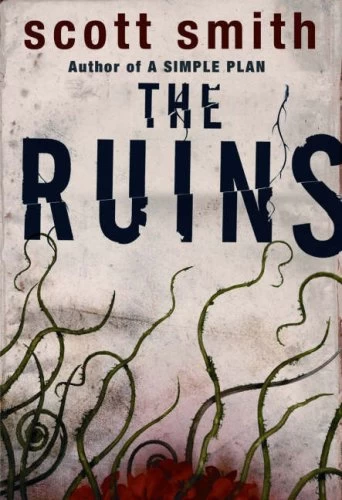
Plotwise, it's like every haunted house story and its variants you ever read or viewed, from Cabin in the Woods to Haunting of Hill House, this one just happens outside, on a hill in the Yucatan jungle, next to an abandoned mine shaft, vines dense around the hill like Friar Tuck's hairstyle, and custodial Mayans chasing tourists away or, if the thrillseekers make it past them, they get an arrow in the throat for trying to leave. Because, believe me, if you're jailed on that pile of death with the mounds of bones peeping out of vine bunches all around you, a cell phone which isn't really a cell phone calling you to the bottom of a darkened shaft so you break your back in the fall trying to find it, yeah, you and your buddies with no food or water to speak of, the couple of girls are no help, and the Greek doesn't speak the language and the German is reticent, stoic; boy, it gets even tougher when your bud thinks the vines have penetrated his skin and he's cuttin' himself, bleeding out all over, everyone getting hysterical, hungry, terrorized, even drunk ‘cause you brought tequila instead of water. Next morning, the Greek with the broken back is still alive, still screaming outside the tent in the mud while the vines strip his legs of flesh. Inside the tent, you hear your own voice mimicked from the jungle, you know the vines are laughing at you, waiting, savoring, enjoying each ghastly encounter, slurping your vomit, drinking all the spilled blood, chewing the dying flesh of your body while you slept. Beyond hope, you know it's not gonna end real well. Even when you try most of the Boy Scout tricks of survival like rain water retention, fire building, rationing the brought twinkies since there's nothing on the hill except those fuckin' vines which are getting bolder, moving in defiance of everything rational, goading you with creepy notions as if they were sentient and doing all this for no other reason than pure, unsullied evil. Will your brain explode from fear, or, will you drift off, mumbling incoherencies like one of the girls does? You didn't think you could hold on through the fear, the horror, the certain death approaching while absorbing more pain, more mental anguish, more grief seeing your friends fall screaming and crying covered in flesh-eating vines. The Ruins is a full-bore rocket-ride of visceral horror. At 319 pages, it's a little verbose as superfluous details and pieces of backstory fill in between the chewfests and frenzied reactions. For those seeking logic and rules in the world, turn to the Eagle Scout as he organizes the group with survival chores, even going as far as suggesting they eat one of their dead. They are all slipping into a fog of insanity from these dire, impossible circumstances, the promises of being rescued become dimmer with each, black-as-tar nightfall. There is no reasonable explanation given for the animated, killing vines(1). With no apparent subtext to muck up the horror, this is that ticking clock rundown to unavoidable death—you know, pretty much what you're denying about your own life path—just compressed with unpredictable circumstances and lots and lots of fear and pain. But that's why you read this kind of fiction, right? As if experiencing it vicariously will somehow ward off experiencing it for real, eh? Well, good luck with that. 1) The closest it gets is one character speculating that whatever the vines are, they came out of the viscera of the earth via the mine shaft, apparently seeking not photosynthesis but something more alive and squirmy.
This is a sequel to Garton's spot-on Live Girls of 1987. Unfortunately it's more of a stain than a spot, as it spills out as an investigative procedural souring with predictability. As a summer read, however, it's damn, ah, lively. Some Stephen King-like author wants to discover if vampires are real. He hires two detectives who find a hidden world of vampires living amongst us, socially structured quite similar to humanity but far more primeval. The club Live Girls in Times Square which was destroyed in a blast from the previous book, is referenced as a bloodsucker's bushwhacking paradise, creating a multitude of don't-wannabe vamps who treat it as an affliction and wear very heavy sunscreen and drink bottled blood. The two brought forth are Casey and Davey(1), working as screenwriters in Hollywood, speculatively the future scripters of True Blood, if they can survive this novel. When our investigators meet them, unwanted connections are made and the Brutals show up, abducting the two girls but leaving the guys for obvious plot reasons. The Brutals. Ahh, the vampires of legendary familiarity. Full-bore sociopaths with fangs, a perchance for darkness and flying around on batwings(2). They've got a fleabag hotel in North Hollywood with 5 stories of locked rooms holding their blood drinking fountains, and they use them in the sex trade business until they look too emasculated and unappealing to their human and post-human customers. Immediately the two girls—Karen and Casey—get slotted for abusive porn filmwork. They are videoed being gang raped and savagely beaten by a dozen guys over and over again. Casey gets the worst of it, culminating when the Brutals send her severed head back to her husband(3). Karen is chosen by the queen Vampirella Anya as her personal sex toy. Meanwhile, the guys are ramping up for an assault on the Royal Arms Hotel with MP5s and stun grenades. Fuck the silver bullets and wooden stakes; it's all about the volume of lead poured into these archfiends until they're a mound of gore. The NRA would be proud. Once the plot gets spanked out of its seeking agenda, it takes off like a howling alley cat. The actions of the two mainplot groups—the vamps and their victims against the investigators and saviors—hook together in alternating syncopation toward the inevitable, big-bang finale. In fact, it reads more like a movie script out of its screenplay format, mainly because author Garton details most indiscriminate actions as if visualizing for the set designers and dialogue blockers, forestalling most use of metaphors and irony and their more evocative, innervational connections. A lot of it reads as filler, as in “he went to the sink and washed his plate and fork clean, then put them on a drain rack to dry. He dried his hands on a hand-towel tied to the handle of the refrigerator . . .”(p.76). However, this bare-ass approach does force the thriller action straight into your face immediately with inescapable captivation. Any subtextual message is absent, too, unless you see this as an apologue about teenage runaways starry-eyed with fame and fortune meeting their unjust rewards by being monetarily forced into the sex and/or the slave trade. In conclusion, this is a passable Summer Read but doesn't contain that wildcat and vanguarding astonishment of Live Girls. Twenty years has softened the original ground of blood-and/as-semen vamp exploitation to the level of soft pornography. On that point, Night Life is lost in the crowded, mad rush to relocate to a trailer park in Bon Temps, Louisiana. 1) Davey Owens is blood-bitten in Live Girls and ends up being the hero who blows the club up. He pretty much repeats that feat here. I guess once bitten, twice shy doesn't apply. 2) There is really no reason for this transmuted affectation. Yeah, pulling Susie out of her convertible BMW as she enters the garage and flying away is a cool visual, but it also adds to the Groan Factor. Although, later finding your wife bunched up on the front door welcome mat as a massive gangbang bruise is quite impressive. 3) Author Garton cops out here. He gives us anal and gang rape scenes, plus lesbian and straight fuck peekaboos, but no decapitation scene, only its consequence. I mean, gorror is gorror, and these monsters are certainly capable of a genuine skull fuck, or, at least, some headless-corpse torso boning mayhem. Oh, come on, don't look at me that way! This is 21st Century, internet-addicted America, you chodas.
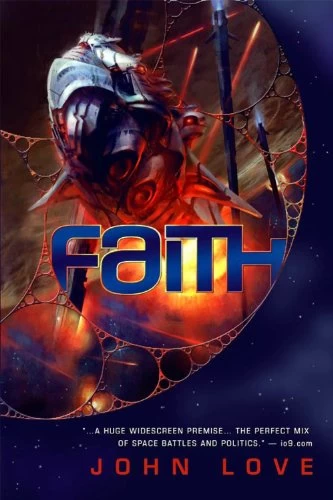
This novel is a marvelous achievement, especially of tone and irony, and especially since it is a debut novel. The premise seems simple at first: a planet-destroying spaceship has appeared and settles in to chewing up the solar system called Horus, a relatively recent acquirement of an expanding Commonwealth of galactic systems spearheaded by us ambitious Earthlings. Horus' main world is Sakhra, housing a civilization of ophidian faced, asexual, reticent and agnostic aliens who'd put together quite an empire themselves of 4 solar systems until—300 years ago—this same ship showed up and the Sakhrans fell into decline and got absorbed by the Commonwealth expansion. The Commonwealth realizes this danger, especially since Faith—Sakhrans' name for the battlestar ship—has knocked out 7 solar systems before showing up at Horus—and sends 1 of 9 of their heaviest warships called Outsiders to deal with the disruption. The Charles Manson has the weaponry, wiles, and miscreant crew you'd expect. Think the Dirty Dozen squad, with the Commander—and the book's elected narrator—a brooding brute named Aaron Foord. Although the ship is 1600 x 300 feet and shaped like a "thin, silver delta"(p.44), it is crammed full to neutron-star density(1), leaving the Command Bridge occupied by a half-dozen sociopaths very, very good at their jobs, but dysfunctional in communicating and/or caring about each other much. One of the strengths of Faith is getting to know these trogs—human and alien alike—even though they are all degenerates of sorts, and experiencing their fumbling hesitations at bonding under life-threatening pressure. Of course, the star of the show—and its biggest cipher—is Faith Herself. When She arrives in the Horus system, She remains cloaked and deadly mischievous. This running battle continues for the bulk of the novel until they finally blow out over Sakhra, and Her mystery remains so until the finale. When you put a conch shell up to your ear, the sound imagines the full ocean in your hand. Well, that's Faith and not its illusion. The key is in the order of magnitude. There's more than just darkness about it; there's also a suggestion of infinity. The more you know, the more room there is for the unknown. Like something continually halving itself where the halves get bigger. —p.368 Author Love's use of irony is direct yet subtle, and calling this menacing spaceship "Faith" is the biggest irony of all. Postscript: The read houses a few plausibility suspects and a structural collapse or two. The first act is a stumbling way to start, evidenced by how fast the novel settles in once the battle begins. And, after the wrapping paper is torn off, the reason the Commonwealth or any bureaucratic organization of such immense size is repugnant to Faith is yet still reasonably unexplained. But what She is is cool, and the conception of this work is so wondrous that it makes the faults seem petty. The third act is executed flawlessly if not a little murky around the edges, but, by that time, I didn't care. Leaving it bittersweet is the ideal combination. And, dropping that last bit of alpha-dog, human arrogance dictating that we can "win" over everything, shows we didn't learn anything from Faith—clearly labeled our most durable and unconquered enemy—after all. Post-Postscript: This read just keeps turning back on me. Now I see a case that Faith represents Al-Qaeda/Taliban/Islam Jihadist and our ineffectiveness to curtail their escalating menace. I mean, why send just 1 ship against it when we have 9? Why fight terrorists on their level when we have instant nuclear disposable methods? Cloaked? When was the last time you saw a terrorist's face outside of a mug shot? Did we defeat Faith? No, just turned her back. She shows up again at Horus, kinda like the Taliban returning in Afghanistan after we ran them out initially. White bread, corn fed Americans know as much about Islam as their future counterparts know about Faith. And, if Faith is emblematic of our foes on the radical edges of the Muslim religion, then they share the goals to stop our expansion based upon, in a large part, what they see as moral disintegration and decadence toward life on the planet. What better way to oppose the merciless tide of an atheistic, greed-inspired, clockwork belief system than with faith, eh? 1) There are 57 other crewmembers aboard but we never meet them.
The aspiration here is not to be a trendy, psychological thriller—although it is that—but a genuine, old-fashioned haunted house yarn. In her preface, Ms. Langan acknowledges her guides through the cobwebs of these stories(1), then launches a unique and fascinating re-imagining of the lynchpin for this sub-genre in her depiction of a once luxurious apartment building in New York City. The Breviary would be an irresistible lure to any passionate architect, and Audrey, being a newly-degreed neophyte to a prestigious Manhattan firm, cannot resist the astonishingly-low cost vacancy caused by a recent act of filicide. Built in 1861 by an iniquitous architectural visionary, it is the last remaining example of Chaotic Naturalism, a quasi-philosophy turned cultus that imagined the world broken away from following any logical pattern recognition. Extended to buildings, the structures tried to model nature — not Euclidian geometry — by shunning right angles, linear progressions and embracing spirals and vine-like growths. But instead they “broke apart these natural patterns into a disjointed mishmash, as if to prove that not even God held providence over man [and] . . . became closed universes unto themselves” (Harper PBO, ISBN 9780061624216, c.2009, p.54). The rich and influential zealots who inhabited lived not only in defiance of gravity, but, as time proved by murders, suicides, and unspeakable depravities, their sanity as well. Sarah's page for video trailer (a must!) http://www.openaudreysdoor.com/trailer/ Characters' choices are rarely judicious in Horror. That's because Horror is never about logic. There's only enough of it there to hold the reader down so emotional responses and/or defenses can shred what's left of their rational mind. Sensory perceptions become suspect as the surroundings change from naturally defined to invariably hostile, intimidating, untrustworthy. And all grounding certainly falls away when your title character is not only OCD, but, as a sympatric co-worker puts it, “You're pretty weird. Like somebody broke you, and you keep trying to put yourself back together, only you do it wrong” (p.137). This is a novel about a girl going fucking bonkers, after all. And she's got such a horrific past that she should go batshit in her own devising. But Audrey's personal demon war is just the appetizer, because the pièce de résistance is always The Breviary; so much so that there's even a whiff of the idea that it represents those old-money, die-hard stringpullers of conservative America that defy change and progress like “gargoyles . . . among the rest of the modern glass condominiums on the block . . . a twisted black tooth along a gleaming white smile” (p.280). Who are the inhabitants from its 150-year span but the inbred, incestuous offspring from legacies the likes of the Robber Barons of yesteryear? This novel won the Stoker for its author this year, making it three Stokers in three years running. I'll bet her next novel will be even better. (1) The author refers to The Haunting of Hill House and The Shining which goalpost the playing field for this sub-genre. Jackson, through Dr. Montague, says “the evil is in the house itself”; King calls the Overlook “the house-as-psychic-battery”. Fundamentally, the house—or hotel—is the spiritual black hole where the psychic and psychotic collide in both dead and living people. But Audrey won't be having her baby among those other evil wretches in Levin's brownstone uptown and, concerning Polanski, I'd hafta say she's substituted Carole--Catherine Denevue's character--from Repulsion of 1965 into Roman's role of 1976's The Tenant, although Ms. Langan doesn't have enough noir in her to script Audrey for that second jump.