
Someone You Can Build A Nest In
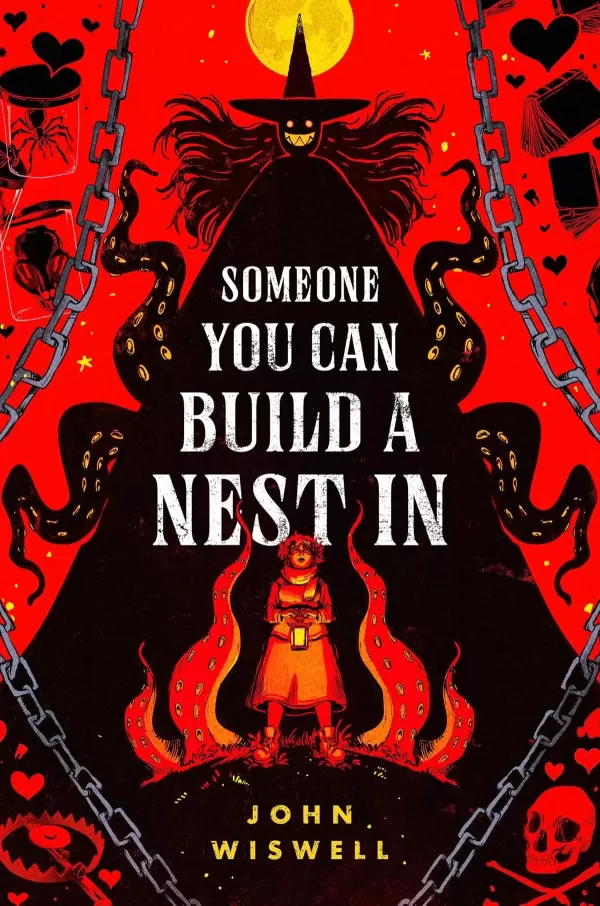
“This unusual queer romance is a heartfelt fable about disability and the possibility of reconciling conflicting needs through love and understanding.” —The Guardian
"Sweetly furious, darkly funny, and gruesomely wholesome. It's a love story for the unloved, a happily-ever-after with a higher-than-average body count. I just adored it." —Alix E. Harrow, New York Times-bestselling author of Starling House
Shesheshen has made a mistake fatal to all monsters: she's fallen in love.
Shesheshen is a shapeshifter, who happily resides as an amorphous lump at the bottom of a ruined manor. When her rest is interrupted by impolite monster hunters, she constructs a body from the remains of past meals: a metal chain for a backbone, borrowed bones for limbs, and a bear trap as an extra mouth.
Badly hurt by the hunters, Shesheshen’s nursed back to health by Homily, a warm-hearted human. Homily is kind and would make a great co-parent: an ideal place to lay Shesheshen’s eggs so their young can devour Homily from the inside out. But as they grow close, Shesheshen realizes that eating her girlfriend isn’t an option.
Just as Shesheshen’s about to confess her identity, Homily reveals something else: she’s hunting a shapeshifting monster that supposedly cursed her family. Has Shesheshen seen it anywhere?
Shesheshen didn’t curse anyone, so now she has to figure out why Homily’s twisted family thinks she did. As Shesheshen’s hunt for the monster becomes increasingly deadly, the bigger challenge remains: learning how to build a life with, rather than in, the woman she loves.

John Wiswell
John Wiswell (b. 1981) is an American author. His debut novel, Someone You Can Build A Nest In (2024), won the Nebula Award in 2024 and the Locus Award for Best First Novel.
More books by John Wiswell

Reviews and Comments

Someone You Can Build a Nest In is a book whose protagonist is neither a human nor any other clearly defined creature. From a human perspective, Shesheshen is a monster that kills people. The creature uses both the bodies of living beings and objects to create a body for itself. Shesheshen’s body is associated with a great deal of physical horror; the descriptions are at times excessively graphic. From the monster’s own perspective, existence is something else entirely. She wants to reproduce and falls in love. She wants to understand what her love is. In all its graphic horror, the work is, in a way, beautiful. It grants permission to be exactly as one is, to feel needs and be demanding, to be accepted. Even love is frightening; it can kill. The work is more than just a story.