Re: Colonised Planet 5: Shikasta
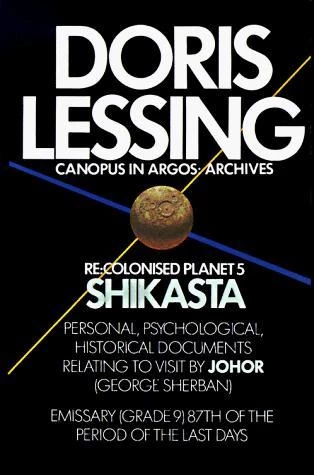
The Devil's supreme achievement is that nobody believes in him. There is a Deity, certainly, but one to be seen within the terms H.G. Wells suggested, that when man cries out his little gimme, gimme, gimme, it is as if a leveret snuggled up to a lion on a dark night. The Old Testament and other sacred literatures of the world may not, after all, be superseded rubbish. These are some of the old ideas Doris Lessing uses in her new and audacious history of the earth. It could be called a stars eye view of things, energetically encompassing millions of years of evolution from the time of lifes beginnings in the warm swamps to mans near-extinction in the Third – and last – World War, soon to be upon us. This war is Shammats (the Devils) victory, but also his defeat; optimism can be defined as the ability to believe that one percent of mankind may survive the wrath to come for a new start under the guidance of The Great Ones who bide Their Times. They watch, and wait, and monitor and adjust human development – employing, for instance, a judicious introduction of celestial genes in crucial epochs, or a supply of Messengers and Technicians whose task it is to warn and to instruct.
In the extraordinary career of Doris Lessing no work has been more ambitious or more startling. Shikasta refuses to be confined within the Western view of history and culture, suggesting that the West is not necessarily seen by other cultures as flatteringly as it sees itself. Can it be classed as space fiction? Perhaps as sociological space fiction, that hybrid genre which takes present or potential social and psychological possibilities to their logical conclusions so that we may examine them, and with determination refuse, or modify, and master them.
Those who have followed Lessings evolution as a writer will recognize in this first book of her visionary novel-sequence, Canopus in Argos: Archives, certain of her old preoccupations transformed and developed on this space-age stage of star-Empires, evolving or dying or damaged planets, celestial management (or mismanagement), the givers of good for mankind and the wicked ones from the thieving planet that preys on us.
This books has in it nothing of permissiveness, of the hope that everything will come all right in the end: it is a return to the older and even traditional concepts of a timeless confrontation between good and evil, dark and light. It is a vision so striking and so powerful that it if certain to be recognized as one of the major works of modern fiction.
Amazon: View on Amazon →
Your Rating
☆☆☆☆☆☆☆☆☆☆
Add to Bookshelf
Readers also enjoyed



Join the Discussion
Doris Lessing
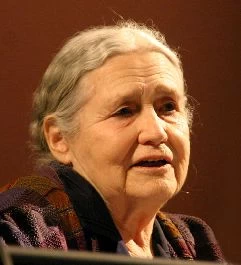
Doris May Lessing CH OMG (née Tayler; 1919–2013) was a British-Zimbabwean (Rhodesian) novelist. She was born to British parents in Iran, where she lived until 1925. Her family then moved to Southern Rhodesia (now Zimbabwe), where she remained until moving in 1949 to London, England. Her novels include The Grass Is Singing (1950), the sequence of five novels collectively called Children of Violence (1952–1969), The Golden Notebook (1962), The Good Terrorist (1985), and five novels collectively known as Canopus in Argos: Archives (1979–1983).
Canopus in Argos: Archives
Canopus in Argos: Archives consists of five books. The current recommended reading order for the series is provided below.