The Making of the Representative for Planet 8
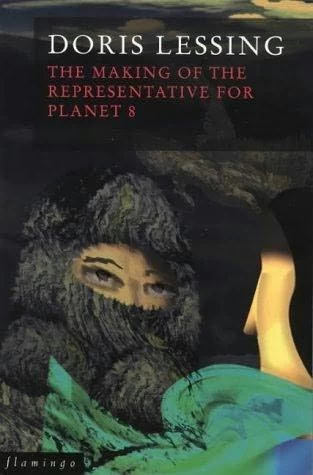
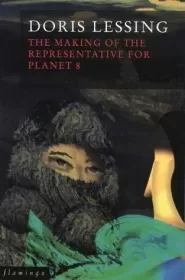
A prosperous and contented little planet that has evolved under the skilled guidance of Canopus learns that an unexpected cosmic mishap will cause it slowly to fail and freeze. The populations who have known only benign and sunny times must learn to live with the development of cold and snow and ice and tundra where recently there was life and pleasantness. But this is not a sad story because the people of Planet 8 become strong and resourceful and they forge from themselves a Representative who is both one and many, who is able to rescue, with the aid of Canopus, from the doomed planet, which will shortly become a lifeless icy pebble, what can and must be rescued, their essential selves. This tale, a metaphor for much else, is also a novelist's contribution to the questions asked so plentifully and restlessly at this time by scientists in that newly discovered area where the new physics meets traditional mysticism.
At the conclusion of the book, the fourth in Canopus in Argos: Archives, comes an afterword, set like the novel, in icy wastes. Doris Lessing tells us that these thoughts belong to The Making of the Representative for Planet 8, but even more to its predecessor, The Sirian Experiments, which novel came to be written as a direct result of nearly fifty years of being fascinated by the two British expeditions to the Antarctic led by Robert Falcon Scott. What concerns her is the way in which demigods of one generation can come under suspicion in the next – how the national biases and unconscious assumptions of a time are essential to an understanding of events. Scott's men were engaged in breaking out of the grasp of ordinary possibility, in transcending themselves – a need in all of us. National certainties of their times – a duty to God, to England, to science – gave them a lofty sense of purpose, if a fatal sense of proportion, known then, at least, as heroism. The year after Scott's expedition limped home without him saw the beginning of the First World War.
Doris Lessing asks us, as she has throughout this extraordinary novel sequence, to look at ourselves, at events in our lives, to see if we cannot find analogues and echoes of startling variety in our world, or even in worlds or dimensions elsewhere.
Amazon: View on Amazon →
Your Rating
☆☆☆☆☆☆☆☆☆☆
Add to Bookshelf
Readers also enjoyed



Join the Discussion
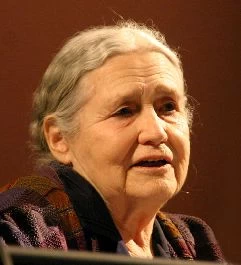
Doris Lessing
Doris May Lessing CH OMG (née Tayler; 1919–2013) was a British-Zimbabwean (Rhodesian) novelist. She was born to British parents in Iran, where she lived until 1925. Her family then moved to Southern Rhodesia (now Zimbabwe), where she remained until moving in 1949 to London, England. Her novels include The Grass Is Singing (1950), the sequence of five novels collectively called Children of Violence (1952–1969), The Golden Notebook (1962), The Good Terrorist (1985), and five novels collectively known as Canopus in Argos: Archives (1979–1983).
Canopus in Argos: Archives
Canopus in Argos: Archives consists of five books. The current recommended reading order for the series is provided below.