Enchanted Glass
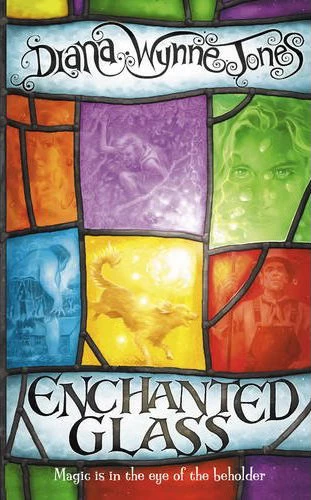
Locus Award nominee 2011.
"As a boy, he had spent fascinated hours looking at the garden through each differently coloured pane. Depending, you got a rose pink sunset garden, hushed and windless; a stormy orange garden, where it was suddenly autumn; a tropical green garden, where there seemed likely to be parrots and monkeys any second. And so on. As an adult now, Andrew valued that glass even more. Magic apart, it was old old old. The glass had all sorts of internal wrinkles and trapped bubbles, and the long-dead maker had somehow managed to make the colours both intense and misty at once."
When the magician Jocelyn Brandon Hope died he bequeathed Melstone House to his grandson Andrew. He also left his "field of care": an area of strangeness surrounding the land around the house, whose boundary Andrew must walk in order to preserve its power.
Andrew had always loved the house, but he finds owning it a lot more complicated, aside from all the magic. There is Mrs Stock, the tyrannical housekeeper who won’t let him move the furniture and punishes him with her terrible cooking. Just as bad is the obsessive gardener who will only grow giant inedible vegetables. To add to his troubles, twelve year old orphan Aidan Cain suddenly arrives on the doorstep begging protection from magical stalkers, and Andrew’s sinister rich neighbour, Mr Brown, begins to encroach on the "field of care". The one compensation is the gardener’s beautiful niece, Stashe. Things become stranger and stranger until all is made clear with the help of the enchanted glass itself.
Not since HOWL'S MOVING CASTLE has Diana Wynne Jones combined romance and humour so successfully as in this delightful novel with echoes of Shakespeare's A Midsummer Night's Dream.
Readers also enjoyed






Diana Wynne Jones
Long before fantasy became mainstream, Diana Wynne Jones was quietly rewriting its rules—building magical worlds that felt both whimsical and wise, mischievous and deeply human. Her stories didn’t just sparkle with enchantment; they carried a quiet intelligence that dared young readers to think deeper, look sideways, and always expect the unexpected.
Born in London in 1934, Jones grew up amid wartime evacuations and an often-chaotic household—experiences that would later inform the strange, shifting families and fractured realities in her fiction. She studied English at Oxford under tutors like C.S. Lewis and J.R.R. Tolkien, though she later remarked she learned more by not imitating them. Instead, she carved out her own voice: lyrical but grounded, funny but never flippant, magical yet steeped in emotional truth.
More books by Diana Wynne Jones