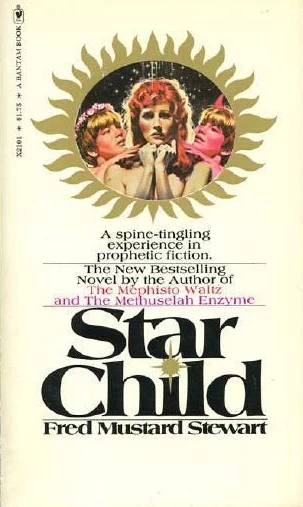
Star Child
"If God did not exist, it would be necessary to invent him." Fred Mustard Stewart considers the fact of a present so unstable that the future is unlikely – and brilliantly invents a "future" to pose salvation for the present.
Star Child is about such a possible near "future" (eighty years on in 2054) and its confrontation with the present (a sleepy little northwest Connecticut town called Shandy). It involves some apparently ordinary townspeople who teach at the local preparatory school, serve on the police force, have dinner parties and hope the world will leave them alone. Which mostly it does, until English teacher Jack Bradford's wife, Helen, begins to have impossible "dreams," of a youth calling himself Star Child, perhaps from star Tau Ceti, twelve light years from the sun. Or perhaps from a place much closer to Shandy, more intimate and terrifyingly personal to Helen Bradford. Fantasy, dream or real? Whichever, Star Child's appearance sets in motion a chain of extraordinary events that seem beyond explanation – unless such future gifts as time-travel, controlled thermonuclear fusion (the only scientific hope for creating a pollution-free environment) and thought-projection through time and space can be accepted in time to save the people of Shandy, and the rest of mankind.