Machines Like Me
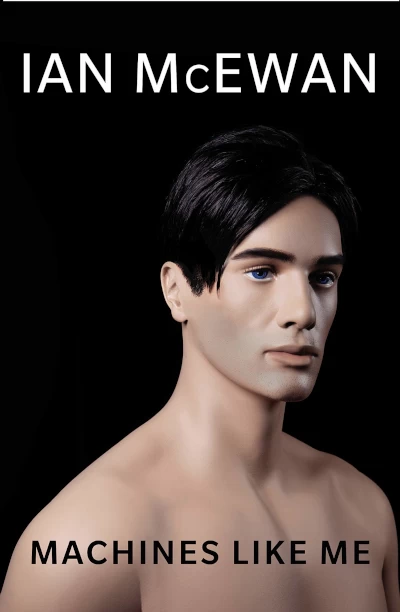
Britain has lost the Falklands war, Margaret Thatcher battles Tony Benn for power and Alan Turing achieves a breakthrough in artificial intelligence. In a world not quite like this one, two lovers will be tested beyond their understanding.
Machines Like Me occurs in an alternative 1980s London. Charlie, drifting through life and dodging full-time employment, is in love with Miranda, a bright student who lives with a terrible secret. When Charlie comes into money, he buys Adam, one of the first batch of synthetic humans. With Miranda’s assistance, he co-designs Adam’s personality. This near-perfect human is beautiful, strong and clever – a love triangle soon forms. These three beings will confront a profound moral dilemma. Ian McEwan’s subversive and entertaining new novel poses fundamental questions: what makes us human? Our outward deeds or our inner lives? Could a machine understand the human heart? This provocative and thrilling tale warns of the power to invent things beyond our control.
‘This is new and exciting ground for McEwan, one of Britain's most consistently brilliant writers.’ Esquire
Readers also enjoyed






Ian McEwan
Some novels ask readers to escape reality. Ian McEwan's fiction does the opposite, drawing them deeper into it, where ordinary moments quietly unravel into moral dilemmas, hidden fears, and life-altering consequences. His stories are rarely driven by spectacle. Instead, they reveal how a single decision, misunderstanding, or chance encounter can echo across decades, making him one of the defining voices of contemporary literary fiction.
Born in Aldershot, England, in 1948, McEwan spent much of his childhood following his father's military postings across Europe, North Africa, and Southeast Asia. Living between cultures gave him an early awareness of displacement, history, and the unpredictability of human experience, themes that would later become woven throughout his novels. After studying English at the University of Sussex, he joined the pioneering creative writing program at the University of East Anglia, where he began shaping the precise, psychologically rich style that would become his hallmark.
More Books Ian McEwan