The Third Rule of Time Travel
Rule One: You can only travel to a point within your lifetime.
Rule Two: You can only travel for ninety seconds.
Rule Three: You can only observe.
The rules cannot be broken.
In this electrifying science fiction thriller from acclaimed author Philip Fracassi, a scientist has unlocked the mysteries of time travel. This is not the story you think you know. And the rules are only the beginning.
Scientist Beth Darlow has discovered the unimaginable. She's built a machine that allows human consciousness to travel through time—to any point in the traveler's lifetime—and relive moments of their life. An impossible breakthrough, but it's not perfect: the traveler has no way to interact with the past. They can only observe.
After Beth's husband, Colson, the co-creator of the machine, dies in a tragic car accident, Beth is left to raise Isabella—their only daughter—and continue the work they started. Mired in grief and threatened by her ruthless CEO, Beth pushes herself to the limit to prove the value of her technology.
Then the impossible happens. Simply viewing personal history should not alter the present, but with each new observation she makes, her own timeline begins to warp.
As her reality constantly shifts, Beth must solve the puzzles of her past, even if it means forsaking her future.
Readers also enjoyed






Philip Fracassi
Philip Fracassi's name might not yet be whispered alongside the giants of horror, but those who have dared to enter the dark and twisted worlds he crafts know that his work leaves a lasting impression. Fracassi’s writing isn’t just about fear—it’s about the way fear clings to the edges of the ordinary, distorting the familiar into something nightmarish. His stories tend to veer into unsettling, psychological terrain, where horror isn’t a matter of what’s seen, but of what’s felt. In his worlds, the scariest monsters are often the ones lurking within ourselves.
More books by Philip Fracassi








Reviews and Comments

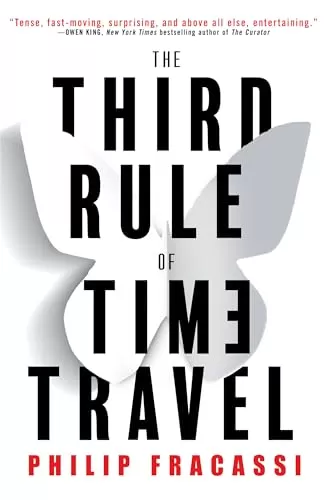
The title of this novel is a marketing department’s dream come true. It’s the kind of title that tells potential readers what the book is about without them even having to read the synopsis. The book is about time travel (obviously). There are rules to traveling through time and the third one is clearly important, and, by implication, will almost certainly be broken. The butterfly (effect) on the cover is also a nice piece of foreshadowing. I fully admit that I judged this book by its cover before I even opened it.
What actually occurs between those covers is a bit of a mixed bag. The premise is straightforward enough: Beth Darlow is a physicist who, along with her late husband Colson, invented a machine that can transport a person’s consciousness back in time to an earlier point in one’s life, where according to the infamous third rule, one can only observe said past event, but cannot affect it. Beth is the only one who is allowed to use the machine, and upon returning from one of her trips she must answer an identical set of questions – and hopefully give an identical set of answers – to those asked before the she activated the machine, to ensure the third rule has held true. Beth also has a sufficiently adorable daughter, Isabelle, who she loves deeply but neglects too often in favor of her work, and an insufferable boss who is trying to get her sidelined from the project. Additionally, there is the question of why Beth’s trips are only sending her back to her most traumatic memories, specifically the plane crash that she survived as a child while her entire family perished, and the night her husband died in a car accident. These elements provide ample dramatic tension to carry the reader’s interest through much of the novel.
The biggest problem with the novel is that most lay, non-scientist persons are already aware of the “observer effect”, so the fact that none of the scientists in the story (least of all Beth) points out the fundamental absurdity of relying on this untenable third rule that threatens their very existence is baffling. The novel’s big twist relies entirely on this fallacy and leads to Beth’s Homer Simpson moment (“Doh! Why didn’t I think of this before!”), unintentionally acknowledging the very fatal flaw that undermines the novel’s premise from the start. Even for readers who were not aware of the observer effect when they picked up the book, the fact that the scientist protagonist fully admits to “forgetting” a fundamental principal that every scientist in the world is aware of is a problem that is difficult to look past.
My interest in the remainder of the novel deflated like a balloon after this. What had otherwise been a well-plotted story with solid, relatable characters turned into a bit of a letdown. Discovering that the answer to the one question that had been bugging me throughout the book – why is no one addressing the observer effect? – is that the author was just hoping I wouldn’t notice, is tough to overlook.