The Legend of Sigurd and Gudrún
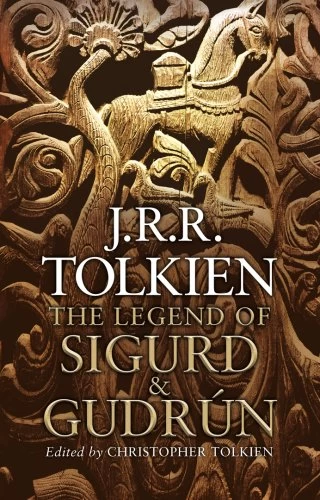
Edited by Christopher Tolkien.
The world first publication of a previously unknown work by J.R.R. Tolkien, which tells the epic story of the Norse hero, Sigurd, the dragon-slayer, the revenge of his wife, Gudrún, and the Fall of the Nibelungs.
“Many years ago, J.R.R. Tolkien composed his own version, now published for the first time, of the great legend of Northern antiquity, in two closely related poems to which he gave the titles The New Lay of the Völsungs and The New Lay of Gudrún.
In the Lay of the Völsungs is told the ancestry of the great hero Sigurd, the slayer of Fáfnir most celebrated of dragons, whose treasure he took for his own; of his awakening of the Valkyrie Brynhild who slept surrounded by a wall of fire, and of their betrothal; and of his coming to the court of the great princes who were named the Niflungs (or Nibelungs), with whom he entered into blood-brotherhood. In that court there sprang great love but also great hate, brought about by the power of the enchantress, mother of the Niflungs, skilled in the arts of magic, of shape-changing and potions of forgetfulness.
In scenes of dramatic intensity, of confusion of identity, thwarted passion, jealousy and bitter strife, the tragedy of Sigurd and Brynhild, of Gunnar the Niflung and Gudrún his sister, mounts to its end in the murder of Sigurd at the hands of his blood-brothers, the suicide of Brynhild, and the despair of Gudrún. In the Lay of Gudrún her fate after the death of Sigurd is told, her marriage against her will to the mighty Atli, ruler of the Huns (the Attila of history), his murder of her brothers the Niflung lords, and her hideous revenge.
Deriving his version primarily from his close study of the ancient poetry of Norway and Iceland known as the Poetic Edda (and where no old poetry exists, from the later prose work theVölsunga Saga), J.R.R. Tolkien employed a verse-form of short stanzas whose lines embody in English the exacting alliterative rhythms and the concentrated energy of the poems of the Edda.” — Christopher Tolkien.
Readers also enjoyed




J. R. R. Tolkien
J. R. R. Tolkien, the creator of Middle-earth, was not just a writer; he was a weaver of worlds, a philologist whose deep understanding of language and mythology breathed life into epic landscapes, timeless characters, and legends that still captivate readers around the world. Born in 1892 in Bloemfontein, South Africa, Tolkien’s early years were marked by tragedy—his father’s untimely death and the loss of his mother, both of which shaped the tone of his writing. His roots in the English countryside, where he moved as a child, became the fertile ground for the stories that would define an entire genre.
More books by J. R. R. Tolkien