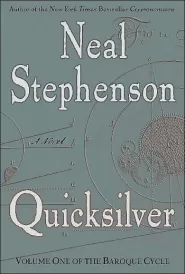
Quicksilver
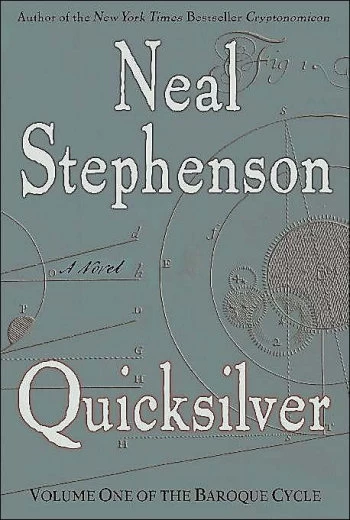
Arthur C. Clarke Award: Best Novel winner (2004).
Quicksilver consists of three books: Quicksilver, King of the Vagabonds and Odalisque.
As extraordinary an achievement as Cryptonomicon, Neal Stephenson's new novel is set in the 17th century, in another world of secrets, codes and conflict. Having challenged Robert Harris in his previous book, Stephenson now sets his sights on Patrick O'Brien... Neal Stephenson follows his international bestseller, the WWII thriller Cryptonomicon, with a novel set in the 16th and 17th centuries, as he tells the stories of Daniel Waterhouse and Enoch Root, the ancestors of his central characters in the previous book, following them from their childhoods in London, to education at Cambridge amidst the political and religious fervour and tensions of the Reformation, through the English Civil War, and travels as far as afield as Poland and the American colonies. With a cast of characters that includes Newton, Leibniz, Christopher Wren, Charles II, Cromwell and the young Benjamin Franklin, Stephenson again shows his extraordinary ability to get inside a place and time; as he did for the futures of his science fiction (Snowcrash, The Diamond Age) and for WWII (Cryptonomicon), here he does for the England of the Civil War and the Europe of the Wars of Religion and the Scientific Revolution. Quicksilver is yet another tour-de-force from a writer who is simply unique.
Readers also enjoyed






Neal Stephenson
In a literary landscape filled with genre walls and boundaries, Neal Stephenson has spent his entire career walking straight through them—sometimes with a sword, sometimes with a quantum computer, often with both. Whether he's dissecting cryptography during World War II or reimagining the architecture of a metaverse long before Silicon Valley caught up, his fiction doesn’t just explore the future, it interrogates the systems that shape it.
Born in Fort Meade, Maryland, and raised in a family steeped in science and engineering, Stephenson was surrounded early on by the kind of analytical thinking that would later permeate his fiction. He studied physics and geography at Boston University, a dual interest that seems almost inevitable in hindsight—his novels often chart the intersections of space, time, history, and human ambition with the precision of a scientist and the curiosity of a historian.
The Baroque Cycle
The Baroque Cycle consists of three books. The current recommended reading order for the series is provided below.