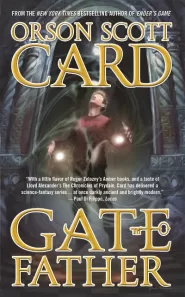
Gatefather

The much-anticipated third installment in Card’s New York Times bestselling Mithermages series
Danny North is the first Gate Mage to be born on Earth in nearly 2000 years, or at least the first to survive to claim his power. Families of Westil in exile on Earth have had a treaty that required the death of any suspected Gate Mage. The wars between the Families had been terrible, until at last they realized it was their own survival in question. But a Gate Mage, one who could build a Great Gate back to Westil, would give his own Family a terrible advantage over all the others, and reignite the wars. So they all had to die. And if the Families didn’t kill them, the Gate Thief would — that mysterious Mage who destroyed every Great Gate, and the Gate Mage, before it could be opened between Earth and Westil.
But Danny survived. And Danny battled the Gate Thief, and won.
What he didn’t know at the time was that the Gate Thief had a very good reason for closing the Great Gates — and Danny has now fallen into the power of that great enemy of both Earth and Westil.
Readers also enjoyed




Orson Scott Card
Before Ender’s Game became required reading in classrooms and a touchstone for science fiction fans worldwide, it was just a short story—one that Orson Scott Card wrote while trying to understand how humanity might survive its own genius. That idea, born of curiosity and a deep interest in moral complexity, would eventually grow into a sprawling series exploring war, empathy, leadership, and the loneliness of brilliance.
Born in Richland, Washington in 1951 and raised mostly in Utah and California, Card grew up in a family where storytelling was a living thing—spoken, passed down, constantly evolving. Though he began his career writing plays and studying literature, he found his true voice in speculative fiction. And when he wrote Ender’s Game—and later Speaker for the Dead—he did something science fiction rarely dared at the time: he treated the genre as a tool for exploring the human soul.
Mither Mages
Mither Mages consists of three primary books, and includes one additional book that complement the series but is not considered mandatory reads. The current recommended reading order for the series is provided below.