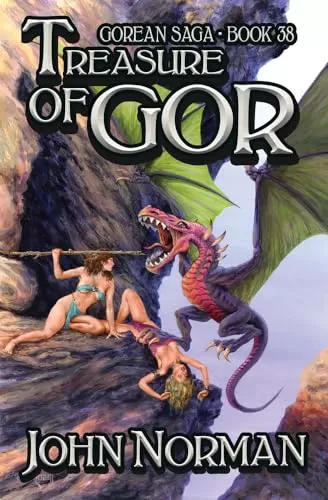
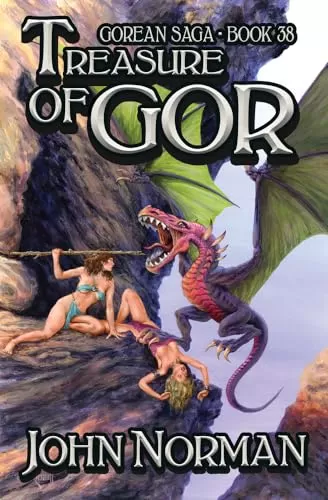
Treasure of Gor
In the open, windswept American southwest, in a remote, lonely area, there exists a small, privately managed, privately financed observatory.
On the surface, there is no reason to regard this institution as different from others of its kind.
It is, however, in at least one respect, quite different, for it serves as a liaison point between the orbiting steel worlds of the Kurii, a technologically advanced, ambitious, ruthless, predatory life form, and the planet Gor, which the Kurii covet, after having destroyed their own world by generations of neglect, greed, and war.
The staff of the observatory, for the most part going about their normal duties, assumes that the nature and activities of the observatory are not other than those familiar to similar institutions.
On the staff, amongst others, is a brilliant, troubled, sensitive, lovely young woman specializing in radar imaging, Agnes Morrison Atherton.
Among the characteristics of her active mind, is a difficult-to-resist, tenacious, dangerous curiosity.
She discovers a file largely unintelligible to her, one which contains mysterious, coded coordinates.
Laboring on her own time and over several nights, she manages to decipher the coordinates which, investigated, reveal two large, spherical objects, apparently artificial, emerged from the asteroid belt.
In the interests of science, of collegiality and transparency, Atherton is excited and eager to share her views and speculations with the senior staff of the observatory.
It seems that whatever might be the nature and purpose of these mysterious bodies, Atherton’s contributions are less than welcome. She is drugged and awakens to find herself stripped and for sale on the planet Gor.
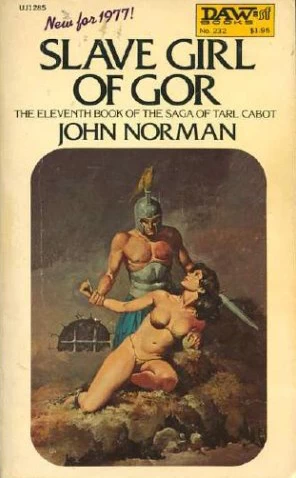
Marked and collared, she begins her life as a Gorean slave girl.