Alien Clay
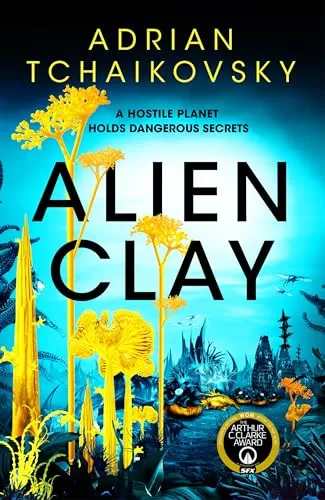
From Arthur C. Clarke and Hugo Award-winning author Adrian Tchaikovsky comes a far-future epic that confirms his place as a modern master of science fiction, in which a political prisoner must unlock the secrets of a strange and dangerous planet.
The planet of Kiln is where the tyrannical Mandate keeps its prison colony, and for inmates, the journey there is always a one-way trip. One such prisoner is Professor Arton Daghdev, xeno-ecologist and political dissident. Soon after arrival, he discovers that Kiln has a secret. Humanity is not the first intelligent life to set foot there.
In the midst of a ravenous, chaotic ecosystem are the ruins of a civilization, but who were the vanished builders and where did they go? If he can survive both the harsh rule of the camp commandant and the alien horrors of the world around him, then Arton has a chance at making a discovery that might just transform not only Kiln, but distant Earth as well.
Readers also enjoyed


Adrian Tchaikovsky
In the realm of speculative fiction, where the boundaries between science and imagination blur, Adrian Tchaikovsky writes with the precision of a biologist and the curiosity of a philosopher. Known for weaving evolutionary theory into alien worlds and giving sentience to the most unexpected of creatures, he crafts stories that challenge not just what it means to be human—but what it means to be alive.
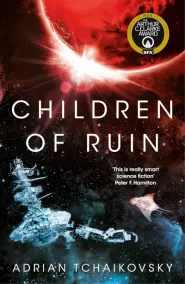
Tchaikovsky’s breakout novel, Children of Time, didn’t just introduce readers to a distant planet populated by hyper-intelligent spiders—it redefined what readers expect from space opera. Bold, cerebral, and emotionally resonant, the book went on to win the Arthur C. Clarke Award, with its sequel Children of Ruin deepening the saga’s exploration of consciousness, cooperation, and survival. In 2023, the Children of Time series earned the Hugo Award for Best Series, a fitting recognition for stories that dare to look evolution in the eye and ask: what if?
More books by Adrian Tchaikovsky