Songmaster
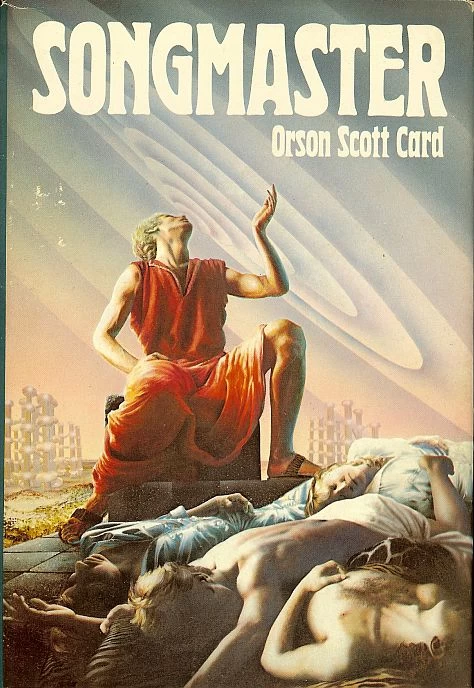
Mikal had conquered most of the inhabited worlds in the Galaxy, and the others tremble in fear of his armies. But he came to the Songhouse on Tew as a suppliant, asking for the services of one of the supremely gifted "Songbirds." It took the better part of a century to find the Songbird suited to Mikal – Ansset, The nine-year-old orphan who had been trained into a singer unequaled in the Songhouse's history.
The battle-scarred old Emperor came to look upon the boy as a son, and so for the first time in his life became vulnerable. It was therefore shocking, but not unexpected, when Mikal's enemies kidnapped Ansset... and turned him into a living weapon of destruction.
Ansset and Mikal surmounted that crisis, but there were others – and, as Mikal foresaw, the day came when he was betrayed and overthrown. The last and hardest lesson he had to teach Ansset was to use his art to its fullest in loyal service to the traitor who had cost Mikal his throne... and his life.
Mikal's legacy sustained his successor and in turn Ansset himself when the responsibility of Mikal's empire fell to him. Yet all his life Ansset knew himself for an exile from the Songhouse as a Songbird who had betrayed his gift by using it to wield power.
There was one way he could return – at an unbearably high cost – and the day came when he took that way.
Readers also enjoyed




Orson Scott Card
Before Ender’s Game became required reading in classrooms and a touchstone for science fiction fans worldwide, it was just a short story—one that Orson Scott Card wrote while trying to understand how humanity might survive its own genius. That idea, born of curiosity and a deep interest in moral complexity, would eventually grow into a sprawling series exploring war, empathy, leadership, and the loneliness of brilliance.
Born in Richland, Washington in 1951 and raised mostly in Utah and California, Card grew up in a family where storytelling was a living thing—spoken, passed down, constantly evolving. Though he began his career writing plays and studying literature, he found his true voice in speculative fiction. And when he wrote Ender’s Game—and later Speaker for the Dead—he did something science fiction rarely dared at the time: he treated the genre as a tool for exploring the human soul.
More books by Orson Scott Card