Capitol
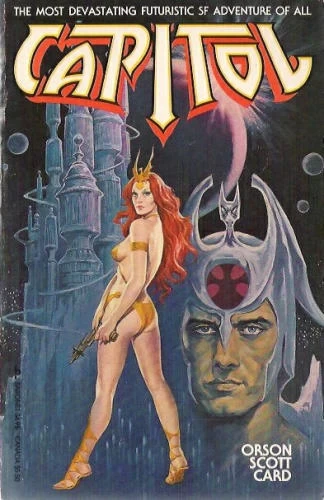
A collection of short stories.
- A Sleep and a Forgetting
- A Thousand Deaths
- Skipping Stones
- Second Chance
- Breaking the Game
- Lifeloop
- Burning
- And What Will We Do Tomorrow?
- Killing Children
- When No One Remembers His Name, Does God Retire?
- The Stars That Blink
Capitol is a world whose only hope is sleep, whose only sleep is death, and whose dreams are fulfilled dangerously often. From the invention of the immortality drug somec which is only available to the privileged few, to a farflung empire on the edge of the galaxy, Capitol traces the fulfillment of mankind's loftiest dreams – and most dismal nightmares. It is not a utopia; but some people manage to find a kind of happiness, a kind of peace, and even, sometimes, a kind of nobility.
You will meet...The telepathic ship captain who inadvertently destroys three planets. The dying prophet who keeps his god alive in the heart of a young boy. The wargaming genius whose greatest creation is undone by the only man who could ever match him. The woman who slowly kills her son – until he murders her, but she comes to visit him in the hospital anyway. Their enemies are powerful. Their lives are cruel. But you won't forget the people of Capitol.
Readers also enjoyed




Orson Scott Card
Before Ender’s Game became required reading in classrooms and a touchstone for science fiction fans worldwide, it was just a short story—one that Orson Scott Card wrote while trying to understand how humanity might survive its own genius. That idea, born of curiosity and a deep interest in moral complexity, would eventually grow into a sprawling series exploring war, empathy, leadership, and the loneliness of brilliance.
Born in Richland, Washington in 1951 and raised mostly in Utah and California, Card grew up in a family where storytelling was a living thing—spoken, passed down, constantly evolving. Though he began his career writing plays and studying literature, he found his true voice in speculative fiction. And when he wrote Ender’s Game—and later Speaker for the Dead—he did something science fiction rarely dared at the time: he treated the genre as a tool for exploring the human soul.
More books by Orson Scott Card